Wedding Shuttle Los Angeles: Complete Guide to Planning 2026

A few years ago we coordinated shuttles for a Downtown LA rooftop wedding where nearly a third of the guests had flown in from Europe — London, Madrid, a handful from Barcelona. They landed at LAX on a Friday afternoon, jet-lagged and excited, and the couple had planned everything beautifully. What nobody had factored in was that the Dodgers had a home game that evening.

Downtown was going to lock up by 4pm — we’ve run routes past Dodger Stadium on game days more times than we can count, and we knew exactly what was coming.

We rerouted every pickup, staged the vehicles on the east side of the venue two hours early, and had the last guest upstairs before the first pitch. The coordinator texted us the next morning: “How did you know?”

That’s really the whole job. A nice bus is easy. Knowing Los Angeles well enough to see the problem before it becomes one — that’s what actually moves 80 guests across a 500-square-mile city without anyone arriving frantic or late.

All Star Shuttles provides wedding shuttle service across Los Angeles and greater Southern California, fully licensed, FMCSA-registered, with itemized quotes and no hidden fees. This guide gives you the same framework our team uses for every LA wedding: venue-specific bus access rules, a multi-hotel guest pickup strategy, and traffic buffer times by route and day of week.

Why LA Weddings Need a Different Shuttle Strategy

Los Angeles spans over 500 square miles. The ceremony venue might be in Malibu; the reception in Downtown; the couple’s hotel in Beverly Hills; and the guests spread across Santa Monica, Pasadena, and Burbank. No other major US wedding market asks shuttle planners to solve this kind of geographic puzzle on a tight timeline.

Add LA’s traffic variability — where a Friday 6pm departure from West Hollywood to downtown can take 25 minutes or 75 minutes depending on the week — and you have a transportation challenge that requires actual route planning, not just “we’ll get there.” The couples who get this right plan every leg in advance. The ones who don’t are the ones guests remember for the wrong reasons.

The 4-Leg Planning Framework

aerial view of Los Angeles for wedding shuttle route planning coast downtown mountains
LA weddings span coast to mountains — the 4-leg planning framework accounts for every transfer.

One of our senior drivers — who’s been running wedding routes in LA for over a decade — has a way of explaining this that we’ve never heard bettered: “Every LA wedding is really four separate trips. Most people only plan for one.” We’ve been building every wedding itinerary around this framework ever since.

Most couples plan legs 2 and 3. The ones who get blindsided forget the other two. Here’s what each leg actually requires:

Leg 1 — Hotels to Getting-Ready Location

Out-of-town guests need to get from their hotels to wherever the bridal party is getting ready. This leg is often forgotten entirely and handled with Ubers — which fails when 20 people need to coordinate pickup from three different hotels during morning rush hour. If your getting-ready location is more than 10 miles from any guest hotel cluster, plan a dedicated vehicle for this leg.

Leg 2 — Getting-Ready Location to Ceremony

The bridal party and guest transfer to the ceremony venue. Build a 30-minute traffic buffer for any cross-town route on a Saturday. This is the leg where late arrivals cause real problems — plan the departure time conservatively and communicate it clearly to guests in advance.

Leg 3 — Ceremony to Reception

Often the longest or most complex leg, especially when ceremony and reception venues are far apart. Continuous-loop service works well here — running the bus between venues so guests who need extra time at the ceremony aren’t stranded. Confirm with your venue coordinator whether both locations have designated bus staging areas.

Leg 4 — Reception Back to Hotels

The return leg is the one most couples understaff. By the time the reception ends, guests are tired, some have been drinking, and the last thing anyone wants is a coordination scramble for Ubers. Run at least one dedicated return shuttle from reception end to the primary guest hotel(s). For large weddings with guests at multiple hotels, plan a route that stops at each cluster in sequence.

Venue-Specific Bus Access Rules in Los Angeles

charter bus at Malibu coastal wedding venue cliffside ceremony setup Southern California
Malibu and coastal LA venues require specific bus staging and permit arrangements.

This is the section no generic guide includes — and the one that catches couples off guard most often.

Getty Center

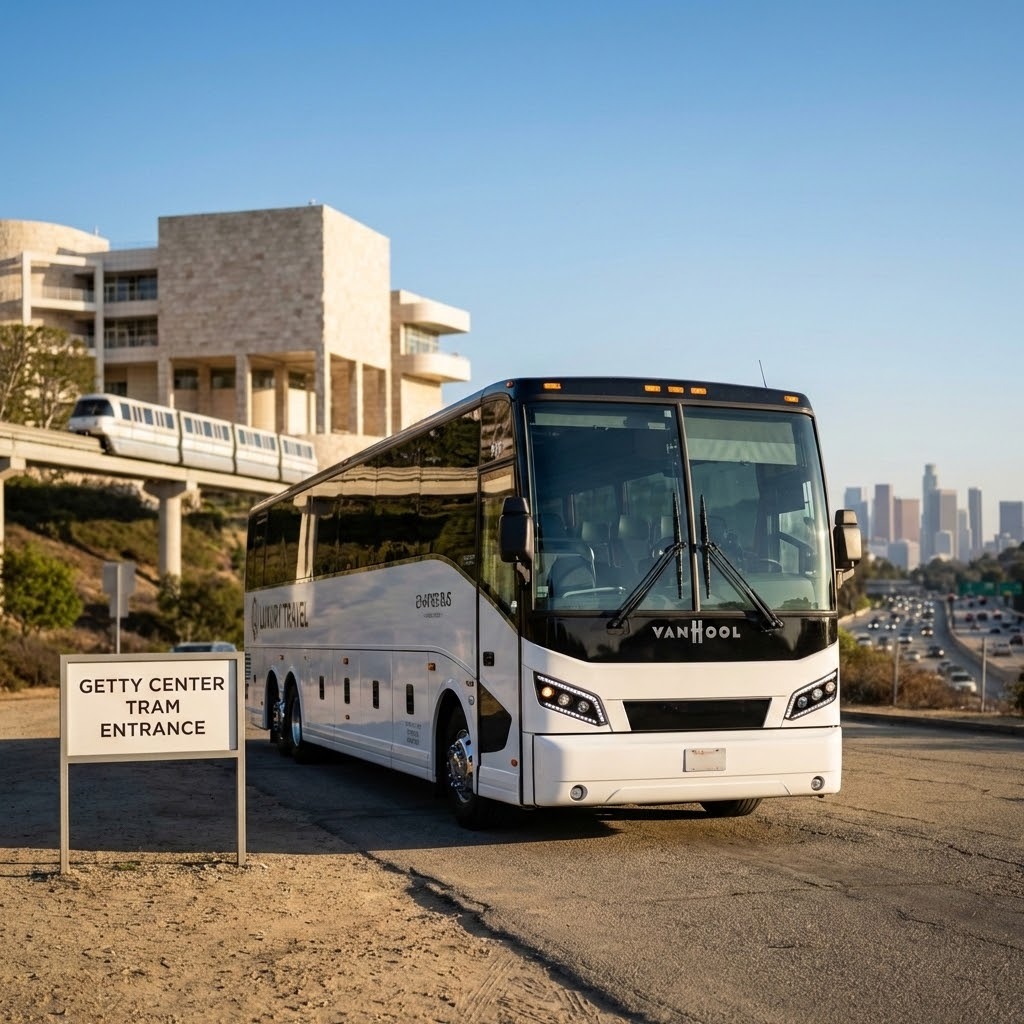
The Getty Center does not allow private charter buses to access the hilltop. All guest transportation must use the Getty’s own tram system from the designated parking structure at the base.

Your shuttle’s job is to transport guests to the Getty parking structure, not to the venue entrance — any provider who promises otherwise doesn’t know the venue.

Build the tram wait time (10–15 minutes) into your schedule and communicate this clearly to guests so nobody is confused about why the bus stops at the bottom of the hill.

Malibu Beach and Clifftop Venues

Malibu venues on PCH (Pacific Coast Highway) often have limited bus pullout space. Confirm bus staging dimensions with your venue coordinator — some can only accommodate one bus at a time, which affects how you schedule continuous-loop arrivals.

Evening departures on PCH can take significantly longer than the same route in daylight due to limited passing opportunities and tourist traffic. Build 45–60 minutes into any post-reception return from Malibu on a Saturday night.

Downtown LA Rooftop and Historic Venues

Downtown LA venues (Vibiana, The Oviatt, Clifton’s, rooftop hotels) require buses to use commercial loading zones, which are often shared with the venue’s own catering and vendor traffic.

Arrive early for load-in to claim your staging position. On weekends, downtown LA parking enforcement is lighter but pedestrian traffic near event venues is high — budget extra time for boarding.

Griffith Observatory Area

The roads to Griffith Observatory are narrow and have weight restrictions for large vehicles.

Full-size coaches cannot always reach the observatory directly coordinate with your venue to confirm whether a shuttle transfer from a lower staging point is required.

Minibuses and sprinter vans are typically the right vehicle choice for Griffith-area venues.

The Out-of-Town Guest Cluster Problem

LA weddings frequently draw guests from multiple cities staying at 3–5 different hotels across the metro — Santa Monica, Beverly Hills, Pasadena, Burbank, and downtown all at once.

A single large coach making sequential stops at each hotel adds 45–75 minutes to the pickup leg and frustrates guests who board early.

The hotel hub strategy: Instead of one bus hitting every hotel, group hotels geographically and assign one smaller vehicle per cluster.

A minibus covering three Westside hotels and a second minibus covering two Pasadena-area hotels is faster, less frustrating for guests, and often more cost-effective than one large coach trying to serve everyone.

Have both buses converge at a single staging point near the venue, not at the venue entrance, then transfer to the final approach together.

Traffic Buffer Rules by Route and Day of Week – Simple Way

These are conservative minimums for Southern California wedding routes. Always err on the longer side for ceremonies with fixed start times.

RouteSat afternoon (before 5pm)Sat evening (after 5pm)Friday evening
Westside → Downtown LA35 min50 min60–75 min
Malibu → Beverly Hills40 min60 min70–90 min
Pasadena → West Hollywood40 min55 min65–80 min
Santa Monica → Griffith area35 min45 min60 min
Downtown → LAX30 min45 min50–70 min

Add 15–20 minutes to any of these estimates during Coachella weekends, major stadium events, or holiday weekends. For a full breakdown of how regional demand affects pricing and availability, see our guide on when to book a charter bus in Southern California.

Wedding Shuttle Fleet Options and Bus Rentals

Fleet Types and Seat Counts

Vehicle typePassenger capacityBest use
Sprinter van10–14Bridal party, VIP guests, airport transfers
Minibus18–28Single hotel cluster, rehearsal dinner, bachelorette
Mid-size coach30–40Medium guest counts, multi-stop routes
Full-size motorcoach45–56Large weddings, continuous-loop service, long-distance transfers

Always add a 10–15% buffer to your confirmed headcount when selecting vehicle size. For trips over 45 minutes, strongly consider a vehicle with an onboard restroom — especially for evening return legs after an open bar reception. Compare options in our charter bus vs. sprinter van guide.

Amenities and Comfort Options

Standard charter buses include reclining seats, climate control, and power outlets. For wedding use, consider requesting: USB charging at every seat (guests will want to charge phones for photos), overhead storage for bags and small items, and PA system capability if you want to welcome guests on the bus. Confirm any decoration policies with your provider — some permit light floral arrangements or ribbon; others have restrictions.

One thing we’ll always tell you upfront: not every LA wedding needs a dedicated shuttle fleet. If your guest count is under 40, everyone is staying at the same hotel, and the venue is within a mile — coordinated rideshare can work fine and cost less. We’d rather tell you that now than oversell you a coach you don’t need. Where shuttles become genuinely essential is the moment you have guests spread across multiple hotel clusters, a venue with no easy rideshare drop-off, or a timeline that cannot absorb 15 minutes of delay on both ends of the night.

Airport Transfers and LAX Shuttle Planning

LAX is the primary arrival airport for most out-of-town wedding guests in Los Angeles. Ground transportation at LAX requires a commercial permit — confirm your provider holds a valid LAX ground transportation authorization before booking airport transfers.

Build 30–45 minutes beyond the scheduled landing time into any LAX pickup to account for baggage claim and the walk to the pickup zone. Collect all arriving flight numbers in advance so your driver can monitor real-time arrivals. For guests arriving at Burbank (BUR) or Long Beach (LGB), separate vehicles are typically more efficient than routing everyone through LAX.

Assign a point person — a family member or wedding coordinator — to manage guest communications on the day of airport pickups. This takes the burden off the driver and ensures no guest is left waiting.

Bachelorette, Engagement, and Rehearsal Dinner Shuttles

Bachelorette parties in Los Angeles gravitate toward West Hollywood, Silver Lake, and Santa Monica for nightlife. A minibus or sprinter van works well for groups of 10–20. Plan a dedicated return route — late-night Uber availability in WeHo is unpredictable and expensive after midnight. For a daytime alternative, a growing number of groups combine the wedding weekend with a Temecula wine country shuttle instead of a bar crawl.

Engagement parties are typically smaller and more intimate — a sprinter van handles most groups comfortably. Confirm vehicle size against your guest count and add a small buffer for plus-ones.

Rehearsal dinners often fall on Friday evenings — the worst possible time for LA traffic. Departure times before 4pm or after 7:30pm dramatically reduce transit time on most LA corridors. If your rehearsal dinner is at a restaurant in a busy corridor (West Hollywood, Culver City, Beverly Hills), plan 60–90 minutes for any cross-city leg departing between 4 and 7pm.

Wedding Day Shuttle Logistics

Continuous Loop vs. Fixed Schedule

Use a continuous loop when: your guest count is large (80+), guests are expected to arrive over a 60+ minute window, or the distance between hotel and venue is under 20 minutes each way. The bus runs repeatedly between pickup and dropoff points, minimizing wait times.

Use a fixed schedule when: you have a smaller, well-organized group, guests are concentrated at one hotel, and the ceremony has a hard start time that benefits from a single coordinated arrival. Communicate departure times clearly in your wedding app or paper program.

Staging and Loading Zones

Confirm bus staging logistics with every venue involved — not just the reception venue. Ask: where does the bus park between runs? Is there a dedicated loading area or do guests board from a public street? For multi-bus setups, what is the vehicle sequencing protocol? Getting these answers before the wedding day eliminates the most common day-of complications.

How to Choose a Wedding Shuttle Service in Los Angeles

Not all charter bus companies approach wedding events the same way. Beyond pricing, verify:

  • FMCSA registration — required for all commercial passenger carriers. Check at FMCSA SAFER
  • Current commercial liability insurance — ask for a certificate of insurance naming your venue as additionally insured if required
  • Driver experience with wedding events — wedding transport requires patience and guest-facing communication skills that differ from corporate shuttle driving. Ask specifically
  • Cancellation and weather policy — Southern California weddings rarely cancel for weather, but confirm what happens if they do
  • Written contract with overtime terms — receptions run long. Confirm the per-hour overtime rate before signing

Comparing Providers and Getting the Right Quote

Request quotes from at least three Los Angeles wedding shuttle providers. When comparing, make sure every quote covers the same scope — same vehicle type, same number of legs, same hours. Providers like Riz Transportation operate in the LA market alongside All Star Shuttles; what matters when comparing is not the brand name but the specifics: is driver gratuity included or added later? Are fuel surcharges itemized? What is the overtime rate?

For a full breakdown of what to watch for in charter bus contracts, see our guide to charter bus rental hidden fees. All Star Shuttles provides itemized quotes with no post-trip surprises — every fee disclosed upfront.

Pricing, Quotes, and Contracts

Wedding shuttle pricing in Los Angeles varies by vehicle size, number of legs, total hours, and date. As a general reference:

  • Sprinter van (half-day): $500–$900
  • Minibus (full-day wedding): $900–$1,800
  • Full-size coach (full-day, continuous loop): $1,800–$3,500+

Always request an itemized quote. Confirm deposit amount and due date, final headcount deadline, overtime rate per hour, and cancellation terms before signing. Understand your California charter bus costs before comparing quotes so you know what’s reasonable. For context on the full fee picture, review our hidden fees guide before signing any contract.

Complete Wedding Shuttle Planning Checklist

  • All 4 legs mapped with pickup and dropoff addresses confirmed
  • Hotel clusters identified and vehicle assigned per cluster
  • Venue bus access rules confirmed with each venue coordinator
  • Guest mobility and ADA needs communicated to provider in writing
  • Flight arrival info collected for all out-of-town guests using airport transfers
  • Traffic buffers built into every leg based on day and time
  • Continuous loop vs. fixed schedule decision finalized
  • Staging and loading zone confirmed at every venue
  • Final shuttle itinerary shared with wedding coordinator, photographer, and DJ
  • Driver direct contact number confirmed 24 hours before wedding day

On-the-Day Roles

Assign a shuttle coordinator — a trusted family member or assistant coordinator — whose only job is managing guest communications related to transportation. This person knows the schedule, has the driver’s number, and is the point of contact for any guest who misses a bus or needs information. This role prevents small logistical issues from reaching the couple on their wedding day.

Drivers should perform a pre-trip vehicle inspection covering fuel, tire pressure, climate control, and cleanliness before the first pickup. Request confirmation from your provider that this happens as standard procedure — reputable charter bus companies build pre-trip inspection into every assignment.

Frequently Asked Questions

How far in advance should I book a wedding shuttle in Los Angeles?

Book 6 to 9 months ahead for peak season (April–October). For dates near Coachella weekends or graduation season, 9 to 12 months is safer. Wedding shuttles in SoCal book faster than almost any other charter bus category.

How many buses do I need for my LA wedding?

Plan for 10 to 15 percent more capacity than your confirmed guest count. If guests are spread across multiple hotels, consider one dedicated minibus per hotel cluster rather than one large coach making multiple stops.

Can wedding guests drink alcohol on the shuttle bus?

This depends on the provider. Confirm the alcohol policy in writing before signing. Some operators permit sealed beverages; others prohibit all open containers. Clarify before the wedding day.

What is a continuous-loop shuttle versus a fixed-schedule shuttle?

A continuous-loop runs repeated circuits between points on a rolling basis. A fixed-schedule departs at set times. Continuous loops work better for larger weddings with staggered arrivals; fixed schedules suit smaller, tightly timed events.

Do I need a permit for a charter bus at my LA wedding venue?

Many LA venues have specific bus access rules. The Getty Center requires all guests to use their own tram from the parking structure. Malibu, downtown, and Griffith-area venues all have staging requirements. Confirm with your venue coordinator before finalizing your transport plan.

How much does a wedding shuttle cost in Los Angeles?

A minibus for a single-hotel group typically runs $900–$1,800 for a full wedding day. A full-size coach running continuous loops can run $1,800–$3,500+. Always request an itemized quote that includes gratuity, fuel, tolls, and overtime terms.

What should I look for when comparing wedding shuttle providers?

Verify FMCSA registration, current commercial liability insurance, and ask specifically about driver experience with wedding events. Request a sample contract and confirm that overtime, gratuity, cancellation terms, and final headcount deadlines are in writing before you pay a deposit.

When to Book a Charter Bus: The Southern California Demand Calendar Every Group Organizer Needs

People always ask, “How far ahead should I book a charter bus?” That’s the wrong question. The real issue is that the California charter bus market is unpredictable.

Southern California’s charter bus market is anything but static. It has predictable demand spikes, regional fleet shortages, and specific calendar dates that drain availability across Los Angeles, San Diego, and the Inland Empire simultaneously.

The smarter question is: what else is happening in SoCal the weekend you need a bus? Answering that turns your booking window from a rough guideline into a decision that saves money and guarantees the vehicle you actually want.

With years of experience helping clients book on time, this writing gives you the Southern California charter bus demand calendar, explains the quote-vs-reservation trap that costs groups their vehicle every year, and delivers lead-time benchmarks by trip type. New to the process? Start with our step-by-step guide on how to book a charter bus. Already past the ideal window? See our last-minute charter bus rental guide instead.

All Star Shuttles serves Los Angeles, Las Vegas , San Diego and San Francisco with transparent, itemized pricing and we’ll walk you through every number before you commit.

The Mistake That Costs Groups Their Bus

A quote is not a reservation. This distinction sounds obvious, until it is not.

Imagine this: a group requests a charter bus quote in January for a May graduation trip. The quote looks good. They share it with the committee, get budget approval, and circle back three weeks later — only to find the bus is gone or the price increased. Another group paid a deposit in the meantime and locked it.

A quote does not guarantee your bus, your deposit does. The rule is simple: if your event is within the next six months, ask your charter bus provider how long they’ll hold the quote and just deposit before that. Simple on paper, seen it fail more than once.

The Southern California Charter Bus Demand Calendar

SoCal has a predictable set of fleet-draining events every year. Knowing these dates helps you understand why availability tightens — and why a booking window that works in February fails completely in April.

charter buses lined up at Southern California festival event transportation staging area
Major SoCal events like Coachella absorb regional fleet capacity — affecting availability for everyone that weekend.
PeriodEvent / DriverFleet Impact
January 1Rose Bowl (Pasadena)LA and IE fleet heavily committed
April (2 weekends)Coachella Valley Music FestivalLA, SD, IE buses redirected to Indio — region-wide shortage
Mid-May – mid-JuneGraduation season (USC, UCLA, UCSD, SDSU, Cal State campuses)Both LA and SD fleets simultaneously absorbed
Late JulyComic-Con San DiegoSan Diego fleet largely unavailable
Aug – SeptSoFi Stadium season opener + concertsLA-area weekend demand spikes
December 1–31Corporate holiday party seasonDowntown LA and SD shuttle demand surges
Memorial Day, Labor Day, July 4Holiday weekendsStatewide leisure travel surge

If your trip date overlaps with any of these, add 4–8 weeks to whatever lead time you would normally use and contact your provider before checking availability elsewhere.

Active now through July 15, 2026: FIFA World Cup 2026 is hosting matches at SoFi Stadium and the Rose Bowl — the biggest fleet-demand event LA has seen in years. If your group has tickets, our FIFA World Cup 2026 Los Angeles transportation guide covers vehicles, venues, and booking windows before fleet sells out.

The Regional Demand Cascade: How Someone Else’s Event Affects Your Price

Here’s what most groups never consider: a sold-out event 40 miles away makes your trip more expensive and harder to book — even if your trip has nothing to do with that event.

When Coachella weekends arrive in April, charter bus companies across Los Angeles, San Diego, and the Inland Empire redirect significant fleet capacity to the Coachella Valley. A corporate group in downtown LA trying to book a Saturday shuttle that same weekend finds fewer available vehicles and higher rates not because their trip is in demand, but because regional supply contracted.

The same cascade happens during Comic-Con (San Diego fleet concentrates at the convention center), Rose Bowl weekend (Pasadena and LA vehicles are locked), and graduation season (every major SoCal campus runs simultaneously in May and June).

Pro Tip: Look at event calendars for places like SoFi Stadium, Crypto.com Arena, Petco Park, the San Diego Convention Center, and major university graduation schedules. If a high-attendance event lands on your weekend, treat your booking window as 4–6 weeks shorter than normal.

Lead Times by Trip Type

With the demand calendar in mind, here are standard lead times for each trip category. These are baselines add time if your date overlaps with any regional demand spike above.

Day Trips and Local Bus Rentals

For local day trips under 100 miles, 1–4 weeks is typically sufficient during off-peak periods. Choose a minibus for groups under 30 passengers to avoid paying for empty seats on a full-sized motorcoach. Confirm hourly minimums with your provider before booking, most require a 4–5 hour minimum regardless of actual trip length.

Overnight and Multi-Day Bus Trips

Book 1–3 months ahead. Overnight trips require driver hotel arrangements, and confirming those logistics takes time. For routes involving more than 10 hours of driving, request an additional driver — federal Hours of Service regulations enforced by the FMCSA limit consecutive driving time, and a second driver keeps your schedule on track. Ask upfront whether driver lodging is included in your quote or billed separately.

Special Events, Weddings, and Conferences

6–9 months minimum. For South California weddings during April–October, 9–12 months is safer. Any graduation-adjacent booking in May or June follows the same rule. Ask your provider directly about blackout dates and high-demand surcharges when you first inquire, not after you’ve fallen in love with a specific vehicle.

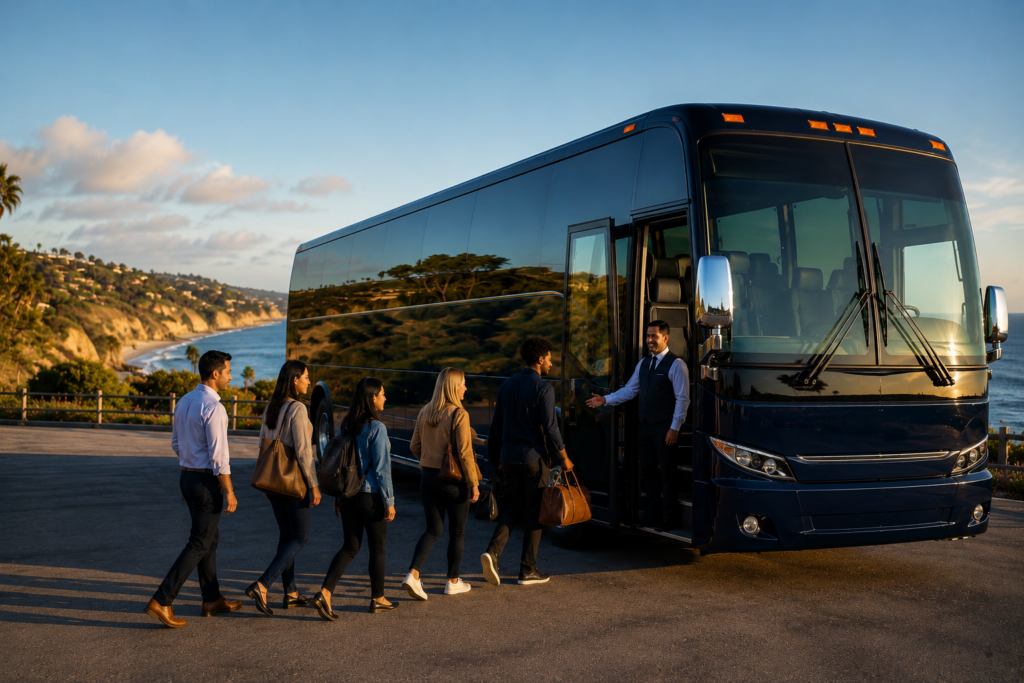
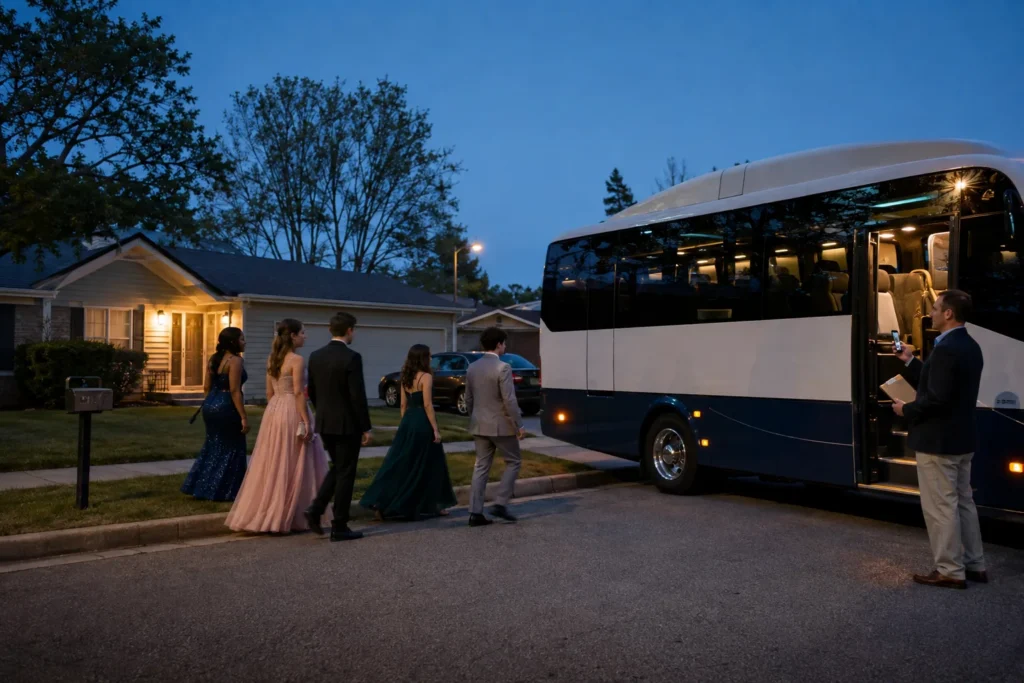
wedding guests boarding charter bus at Southern California venue at sunset
Wedding shuttles in SoCal peak season book out 6–9 months ahead — sometimes more.

ADA-Accessible Bus Planning

ADA-accessible buses with wheelchair lifts and securement features represent a smaller share of most fleets. Request them 4–8 weeks ahead for standard off-peak trips, and 3–6 months ahead for any peak-season event.

Be specific when you request: wheelchair dimensions, mobility equipment type (power vs. manual), transfer assistance needs, and whether securement points are required. Vague requests produce vague availability. Specific requests get confirmed equipment and written documentation.

How Your Charter Bus Company and Drivers Affect Timing

Fleet Size and Vehicle Availability

Fleet size matters more than most groups realize. A smaller operator with 8–10 vehicles has far less short-notice flexibility than a larger fleet. When you inquire, ask specifically how many vehicles the company operates and confirm your exact bus type is available — not just “a bus.” A company that can’t answer that question quickly is a company running close to capacity.

Driver Scheduling and Hours-of-Service Rules

Driver scheduling is a timing factor most groups overlook. Federal Hours of Service regulations limit how many consecutive hours a professional driver can operate, which affects your route planning and departure times. For multi-day trips, confirm whether driver hotel costs are included in your quote or added later — and get that confirmation in writing before paying a deposit.
Request a direct contact number for your assigned driver at least 24 hours before departure. This is standard practice at reputable charter bus companies and eliminates day-of confusion entirely.

Booking Process: From Quote to Confirmed Reservation

  1. Request a written, itemized quote — not a verbal estimate
  2. Confirm deposit amount and due date (typically 20–30% of total)
  3. Review cancellation and refund policy before paying anything
  4. Pay deposit to secure the vehicle — this is when your reservation is confirmed
  5. Receive written confirmation with trip details, vehicle type, and driver contact
  6. Confirm final headcount and pickup locations 48–72 hours before departure

The window between steps 1 and 4 is where groups lose buses — especially during peak season. Don’t sit on a quote for more than a few days if your travel date falls anywhere near the demand calendar above.

Pre-Booking Checklist

Before you reserve any charter bus rental:

  • Headcount and luggage requirements finalized
  • Vehicle type selected (full-size motorcoach, minibus, school bus)
  • Required amenities confirmed (power outlets, restrooms, reclining seats, ADA lift)
  • Pickup and drop-off addresses confirmed and precise
  • ADA and special passenger needs communicated in writing
  • SoCal demand calendar checked for your travel weekend
  • Quote confirmed as itemized and in writing before deposit

Special Use Cases: Sports, Weddings, and Corporate Shuttles

Sports Teams

Tournament windows create compressed short-notice demand. Book as early as the schedule allows — often the moment brackets are announced. If your team travels frequently, talk to a charter bus provider about a seasonal agreement that covers multiple trips at a negotiated rate.

Weddings

6+ months minimum in SoCal — full stop. Coordinate with your venue on bus parking and loading logistics at the same time you book the bus. Many Southern California venues have specific loading rules for large vehicles that affect your timeline. See our guide to wedding shuttle service for what to confirm before the big day.

Corporate Recurring Shuttles

Employee shuttle programs work best when arranged months before the program start date. Route optimization, recurring driver assignments, and invoicing setup take time to coordinate properly. Our corporate shuttle service team handles recurring programs across Los Angeles and San Diego — the earlier you start the conversation, the better the setup.

How to Secure Better Rates on Charter Bus Rentals

  • Travel off-peak and on weekdays — weekday rates typically run 10–20% lower than weekend pricing
  • Book the right-sized bus — a 56-passenger motorcoach for 25 people costs significantly more than a minibus that fits your group
  • Bundle multiple days — multi-day flat rates often beat per-day hourly billing on longer trips
  • Avoid demand-spike weekends — if your event date is flexible, shifting one weekend can meaningfully reduce the price
  • Ask about early-booking discounts — some providers offer reduced rates for reservations made 90+ days out

For a detailed breakdown of what drives California charter bus costs — including per-mile vs. hourly billing, fuel surcharges, and deadhead miles — see our full pricing guide.

Day-Of and Post-Trip Actions

  • Confirm pickup time directly with your driver the morning of the trip
  • Have the driver’s direct contact number before you leave
  • Prepare driver gratuity in cash (15–20% of the rental fee is standard)
  • Inspect the bus before boarding and note any pre-existing damage
  • Report any post-trip issues to your provider within 24 hours

Frequently Asked Questions

What is the difference between a charter bus quote and a reservation?

A quote gives you a price estimate — it does not hold the vehicle. A deposit secures the bus. Until you have paid and received written confirmation, the bus is available to anyone else who calls. Never assume a quote is a reservation.

When is the worst time of year to book a charter bus in Southern California?

April is the most difficult month due to Coachella, which absorbs fleet capacity across LA, San Diego, and the Inland Empire. May and June follow closely because of graduation season. December corporate holiday party season is a close third.

How far ahead should I book a charter bus for a wedding in Los Angeles?

6 to 9 months minimum for peak season (April–October). For dates near holidays or graduation weekends, 9 to 12 months is safer. Wedding shuttle buses move fast in the SoCal market.

Does Coachella really affect charter bus availability in Los Angeles?

Yes. Coachella spans two weekends in April and draws charter buses from across Southern California. Groups in LA, San Diego, and the Inland Empire who need buses those same weekends face reduced availability and higher rates — even if their trip has nothing to do with the festival.

Can I change my headcount after booking a charter bus?

Most providers allow headcount adjustments up to 48–72 hours before departure, though changing vehicle size may affect pricing. Confirm the change policy in writing at time of booking.

What happens if I need to cancel a charter bus reservation?

Cancellation policies typically use a tiered refund structure — full refund far enough in advance, partial refund closer to the date, no refund within 14–30 days of departure. Always review the cancellation policy before paying your deposit.

How do I know if my travel weekend has high regional demand in SoCal?

Check event calendars for SoFi Stadium, Crypto.com Arena, Petco Park, the San Diego Convention Center, and major SoCal university graduation schedules. If a large event lands on your weekend, treat your booking window as 4–6 weeks shorter than normal and contact your provider right away. For current rate ranges by season and vehicle type, see our charter bus pricing per hour California guide.

Charter Bus Rental Hidden Fees: What Every Group Organizer Needs to Know

You get a quote for a charter bus rental and the number looks reasonable. Then the invoice arrives — and it’s $400 higher than expected. That gap between the quoted price and the final cost is where hidden fees live, and they catch group organizers off guard every year.

Whether you’re planning a school field trip in Los Angeles, a corporate shuttle for a local tech company, or a day trip to San Diego, understanding charter bus rental hidden fees before you sign anything protects your budget and your credibility. This guide breaks down every charge category that can inflate your total cost, shows real-world examples, and gives you a checklist to use before paying any deposit.

All Star Shuttles operates differently — every quote includes itemized fees upfront, so the number you see is the number you pay.

What This Guide Covers

  • School administrators organizing field trips
  • Corporate event planners managing employee transportation
  • Social group organizers planning day trips or overnight travel

Examples draw heavily from Los Angeles, San Diego, and Southern California routing, though the fee structures apply to group transportation nationally.

Core Hidden Fees That Change Charter Bus Pricing

charter bus driver reviewing itemized rental quote before trip

The base hourly rate or per-mile rate on a quote is rarely the whole story. Here are the charges most likely to inflate your final cost.

Deadhead Miles and Empty-Route Charges

Deadhead miles refer to the distance the bus travels to reach your pickup location — without passengers aboard. Most providers charge for these because the driver and vehicle are still in use during that time.

For example, if a charter bus depot is 30 miles from your pickup point, you may be billed for those 30 miles at the standard per-mile rate before the trip even begins. On a long-distance trip from Los Angeles to San Diego, deadhead charges can add $75–$150 to your total cost depending on bus size and the provider’s origin point.

How to reduce deadhead: Consolidate your group into a single pickup point as close as possible to the provider’s dispatch location. Ask your reservation specialist explicitly whether deadhead miles are included in the quote.

Minimum-Hour Rules and Hourly Pricing Traps

Most charter bus providers enforce a minimum rental period — typically 4 to 5 hours — regardless of how long you actually need the bus. If your trip runs 2.5 hours round-trip, you still pay for a full 4-hour block.

Example: A corporate shuttle from downtown Los Angeles to a venue 45 minutes away takes about 2.5 hours total. At $185/hour with a 4-hour minimum, the bill is $740 — not $462. That’s a $278 difference most planners don’t anticipate.

For short local trips or shuttle bus runs within a single venue, ask whether the provider offers a lower minimum. Some will negotiate to a 3-hour block for straightforward routes.

Driver Lodging and Overnight Trip Costs

Any trip that requires a driver to stay overnight generates additional costs. Federal Hours of Service regulations enforced by the Federal Motor Carrier Safety Administration (FMCSA) limit how many consecutive hours a professional driver can operate, which means multi-day trips require planned rest stops and, in most cases, a hotel room for the driver.

Providers typically charge $100–$200 per night for driver lodging on top of the base rental fee. For a 3-day trip, that’s $300–$600 in lodging fees alone.

Best practice: Always ask for written confirmation of the driver hotel policy before signing. Request that the quote line-items driver lodging separately so you can verify the amount later.

Fuel Surcharges and Long-Distance Bus Rental Costs

Fuel surcharges appear most often on long-distance trips and are calculated either as a flat per-mile charge or as a percentage added to the base rate when fuel prices exceed a threshold. Ask any provider: what is the current formula, is it per-mile or percentage-based, and at what fuel price does it activate?

For a 56-passenger charter bus traveling from Los Angeles to Las Vegas (roughly 270 miles each way), fuel-related travel fees can range from $80 to $200 depending on current prices and the provider’s policy.

Tolls, Permit Charges, and Parking Fees

Any route that crosses toll roads — such as sections of the I-15 or SR-73 in Southern California — generates toll charges typically passed directly to the client. Request an itemized toll estimate for your specific route before signing.

Parking Fees at Stadiums, Hotels, and Event Venues

Large buses require commercial vehicle parking spaces. At major stadiums in Los Angeles and San Diego, oversized vehicle parking can run $50–$150 per event. Hotels near convention centers typically charge $35–$75 per night for coach parking. Contact your destination venue directly to confirm rates and whether advance reservation is required.

Permit and Loading-Zone Costs

Pickups near airports or at special events in downtown LA may require commercial vehicle permits ranging from $25 to several hundred dollars. Check requirements early and ask your provider whether they handle permit applications and whether the fee is included in your quote or billed separately.

Cleaning, Damage, and Gratuity Fees

Ask what the threshold is for a supplemental cleaning fee and what damage liability limits apply under the rental agreement. Driver gratuity (15–20% of the rental fee) is typically the client’s responsibility and is rarely included in quotes — decide your policy before trip day.

Last-Minute Booking Penalties and Seasonal Surges

Booking within 2–3 weeks often triggers a 10–25% last-minute premium. Peak seasons in Southern California compound this further. Book 4–6 weeks ahead for standard trips, 2–3 months for major events or holidays. Ask providers for their seasonal rate calendar, and follow our guide on how to book a charter bus to avoid surprises.

Route Changes, Extra Stops, and Itinerary Fees

Changes after signing typically cost $25 per change or trigger full re-rating of the trip. Ask for change-deadline policies and per-change fee schedules before signing. Locking your final itinerary early is the single most effective way to control charter bus rental costs beyond the base rate.

Case Studies: Real-World Fee Breakdowns

corporate employees boarding charter bus for Los Angeles shuttle event

School Field Trip Bus Rental Costs

A Los Angeles elementary school books a full-day field trip — 8 hours — for 52 students, traveling from school to the Natural History Museum and back.

Line itemEstimated cost
Base rate (8 hours x $155/hr)$1,240
Deadhead miles (18 mi x $3.50)$63
Museum parking (commercial lot)$65
Driver gratuity (15%)$186
Estimated total$1,554

Schools should also request written proof of FMCSA registration and — for California public school trips — SPAB certification from the California Highway Patrol. These are non-negotiable safety requirements.

Corporate Event Shuttle Bus Pricing

A local tech company in downtown LA needs a corporate shuttle to transport 35 employees from the office to an offsite event venue 22 miles away, with a return trip 5 hours later.

Line itemEstimated cost
Base rate (5-hour minimum x $165/hr)$825
Fuel surcharge (44 mi round-trip)$55
Tolls (I-10 corridor)$18
Estimated total$898

For corporate accounts, request itemized invoicing on company letterhead, the ability to confirm final employee headcount 48 hours before the trip, and a named account manager for last-minute changes.

Day Trip vs. Multi-Day Overnight Trips

Trip typeBaseDriver lodgingEst. total
Day trip (10 hrs)$1,550—~$1,750
Overnight (2 days)$2,400$150/night~$2,800

When the itinerary is flexible, per-day flat rates can beat hourly billing for overnight trips — ask your provider whether that option exists. Scheduling driver rest near the destination also reduces total mileage fees.

San Diego Specifics: Local Fees and Best Practices

The I-15 Express Lanes and SR-125 South Bay Expressway both charge tolls for commercial vehicles — get a written toll estimate for any San Diego routing before booking. Balboa Park bus parking is limited and often requires advance reservations. San Diego International Airport (SAN) requires a valid commercial ground transportation permit for any pickup or dropoff at the terminal. Always request an itemized local fee estimate for any San Diego itinerary covering tolls, parking, and venue-specific permit costs.

Transparent Pricing Practices to Demand

  1. Is deadhead mileage included in this quote?
  2. What is the minimum rental period?
  3. Are driver lodging fees included for overnight trips?
  4. What is the current fuel surcharge formula and threshold?
  5. Are tolls and parking estimated in this quote or billed post-trip?
  6. What is the cleaning fee threshold and damage liability cap?
  7. What is the deadline for free itinerary changes?
  8. Is gratuity included or expected separately?

Any provider unwilling to answer these in writing before you pay a deposit is a red flag. A professional transportation services company has nothing to hide in its pricing.

Why All Star Shuttles Is Different: No Hidden Fees

All Star Shuttles charter bus at Southern California coastal location

All Star Shuttles was built around transparent pricing. When you request a quote, every applicable fee is itemized upfront: deadhead, fuel surcharges, driver pay, tolls, and any permit costs specific to your route. The number you approve is the number you pay.

Our charter bus rental quotes include driver compensation guidance stated clearly, fuel surcharge disclosed at time of quote, itemized toll and parking estimates for your specific route, and a written driver lodging policy for any overnight trip.

All Star Shuttles serves Los Angeles, San Diego, and Southern California with a fleet that includes full-sized charter buses, sprinter van rentals, and school bus rentals. Whether you’re comparing a charter bus vs. sprinter van or trying to understand California charter bus costs, we’ll walk you through every number before you commit.

How to Compare Charter Bus Prices

When evaluating providers, compare total estimated cost for your specific trip — not just base rates. Factor in trip length, vehicle type, passenger count, deadhead distance, and venue-specific parking or permit requirements.

Quick Comparison Table: Charter Bus Fees by Provider Type

Fee categoryBudget providersMid-tier providersAll Star Shuttles
Deadhead milesOften undisclosedItemized on requestIncluded in quote
Fuel surchargeTriggered without noticeDisclosed at bookingDisclosed at quote
Driver lodgingAdded at invoicingEstimated at bookingWritten policy upfront
Tolls & parkingBilled post-tripEstimated on requestItemized in quote
GratuityAmbiguousSuggestedClearly stated
Hidden feesCommonOccasionalNone

Negotiation Tips to Avoid Surprise Charges

  • Ask for a capped toll and parking estimate — a maximum the provider won’t exceed — rather than an open-ended “actual cost” clause
  • Request written confirmation for any fees the provider agrees to waive
  • Offer a flexible pickup point to reduce deadhead miles
  • For recurring corporate transportation, negotiate a flat monthly rate that absorbs fuel and toll variability

Final Pre-Booking Checklist

  • Received itemized written quote covering all fee categories above
  • Confirmed minimum rental hours match your actual trip duration
  • Verified driver lodging policy for overnight trips
  • Obtained written toll and parking estimate for your specific route
  • Confirmed cancellation and change fee schedules
  • Contract states all fees included or lists each explicitly
  • Confirmed FMCSA registration and insurance (schools: also SPAB certification)
  • Gratuity policy discussed and decided before trip day

Frequently Asked Questions

What are deadhead miles in charter bus rental?

Deadhead miles are the miles a charter bus travels to reach your pickup location without passengers. Most providers charge for these because the driver and vehicle are still in use. Ask your provider to include or itemize deadhead in your quote.

Why is my charter bus rental invoice higher than the quote?

Common reasons include unbilled fuel surcharges, post-trip toll and parking charges, last-minute change fees, or gratuity added after the fact. Request an itemized written quote before signing to avoid these gaps.

Do charter bus companies charge for driver hotel rooms?

Yes, on overnight or multi-day trips, providers typically add $100–$200 per night for driver lodging. FMCSA Hours of Service regulations require mandatory rest periods. Always confirm this in writing before booking.

How far in advance should I book a charter bus?

Book at least 4–6 weeks in advance for standard trips to avoid last-minute premiums. For holiday weekends or large events, 2–3 months ahead is recommended.

Are tolls included in a charter bus rental quote?

Not always. Many providers bill actual toll costs after the trip. Ask for a written toll estimate for your specific route and request a capped maximum if possible.

Is gratuity included in charter bus rental prices?

Usually not. Driver gratuity (15–20% of the rental fee) is typically the client’s responsibility. Clarify this before trip day so there’s no awkward scramble at the end.

What permits does a charter bus need in Los Angeles?

Commercial ground transportation permits may be required for pickups at LAX, certain downtown zones, and special events. For California school trips, drivers must hold a SPAB certificate from the California Highway Patrol. Ask your provider to confirm all permits for your specific route and venue. For a full hourly rate breakdown including all fees, see our charter bus pricing per hour California guide.

Corporate Shuttle Service Los Angeles: How Allstar Shuttles Keeps Business Moving

Corporate shuttle bus parked at Los Angeles office campus — Allstar Shuttles

Running a corporate shuttle program in Los Angeles is not a simple operation. The city spans hundreds of square miles, traffic patterns shift by neighborhood and by season, and your employees are counting on a vehicle that shows up on time every single day. At Allstar Shuttles, we’ve built our corporate program around exactly that — not just a clean vehicle and a professional driver, but a full operation backed by dedicated dispatch, route planning, and real driver accountability. Whether you’re looking to get employees to work reliably, move groups to a conference, or run airport pickups for executives, this guide walks you through how we work and what to expect.

What Our Corporate Shuttle Service Covers in Los Angeles

Corporate transportation in LA looks different for every client. Some companies need a daily commuter route between a Culver City campus and the Metro Expo Line. Others need airport pickups every morning from LAX, Burbank (BUR), or Long Beach (LGB) for traveling executives. A few need event shuttles for quarterly offsites or trade shows at the Los Angeles Convention Center. Film, TV, and commercial productions need something else entirely — see our production crew transportation page for how that works.

We handle all of it. Our corporate service includes recurring employee commuter routes, executive airport transportation to LAX, BUR, LGB, and Ontario (ONT), corporate event and conference shuttles, and one-time group charters for team transportation. Our dispatch team operates 24 hours a day, seven days a week. If a flight lands at 2 a.m. or a shift starts at 5, we’re already moving. That’s not a marketing line — it’s how we staff our operation, and it’s the baseline expectation any corporate client should hold their shuttle provider to.

Why Employee Shuttles Give LA Businesses a Real Advantage

The average Los Angeles commute runs well over an hour each way. For employees driving from the San Fernando Valley to Century City, or from Long Beach to El Segundo, that’s real time lost — and over months, it grinds people down. Companies that provide employee shuttles consistently report lower turnover in roles that have longer commutes attached to them.

HR managers we work with point to the shuttle program as a concrete recruiting differentiator — something that shows up in job postings and gets mentioned in interviews. It’s not a vague perk. It’s a commute solution that candidates can actually picture themselves using.

On the cost side, every seat filled on a shuttle is one fewer car your facility needs to park. In Los Angeles, commercial parking runs $200 to $400 per stall per month. A 30-seat minibus replacing 25 single-occupancy vehicles offsets a meaningful portion of its own operating cost. There’s also a carbon story — fewer cars on the road means lower emissions, which matters for companies with sustainability reporting commitments or ESG goals.

Fleet Options: Charter Bus, Minibus, or Sprinter Van?

We match the vehicle to the route, not the other way around. Here’s a straightforward breakdown of what we operate and when each makes sense for a corporate program:

VehiclePassenger CapacityBest For
Sprinter Van12–14 passengersSmall teams, short routes, executive transfers
Minibus24–35 passengersMid-size commuter routes, event shuttles
Charter Bus40–57 passengersLarge groups, all-day events, multi-stop routes

For most corporate commuter routes under 20 miles with 10 to 20 employees, a Sprinter van is the right call — easier to route through surface streets, lower operating cost, and simpler to scale as headcount changes. For routes with 25 to 50 employees crossing the city, a minibus gives you the comfort and capacity you need without the footprint of a full coach. If you’re moving 50 or more people — a full shift group, a large corporate event — a charter bus is the right tool. ADA-accessible vehicles are available across all vehicle classes; if you have employees who use mobility devices, tell us during the planning phase and we configure the right vehicle from the start.

Not sure which vehicle fits your headcount and route? Our charter bus vs. Sprinter van guide breaks down the decision by group size, route length, and budget.

Allstar Shuttles fleet vehicles — Sprinter van, minibus, and charter bus for Los Angeles corporate clients

Custom Routes, Shift Coverage, and Last-Mile Connections

Before we quote a corporate program, we do a route assessment. That means looking at where your employees actually live, where your facility is, and how we can design a route that people will use. A shuttle route nobody rides is not a solution — it’s an expense. We design routes based on real ridership data, not assumptions.

For shift-based operations — logistics companies, production studios, healthcare facilities — we build separate schedules for each shift window and can accommodate split shifts and surge days without pulling in outside contractors. One area that gets overlooked in most corporate shuttle programs is the last mile. If a significant portion of your employees use Metrolink or Metro rail, connecting your shuttle to Union Station, El Monte, or Chatsworth dramatically increases adoption. We’ve designed routes specifically around transit connectivity, and it consistently improves ridership numbers.

Driver Standards and How We Keep Daily Operations Tight

Every driver assigned to a corporate account goes through a full background check, DMV pull notice review, and medical clearance before their first shift. These aren’t one-time checks — we run continuous monitoring on all active drivers throughout their time on the program.

Pre-trip vehicle inspections happen every day before a driver pulls out of the yard. Tires, brakes, fluid levels, lighting, emergency equipment — any vehicle that doesn’t pass inspection doesn’t move. Our drivers wear uniforms on corporate accounts and are trained on passenger conduct standards, disability assistance, and how to handle schedule deviations without disrupting the experience for riders. California commercial passenger carriers are required to meet California Highway Patrol safety and inspection standards — we’re fully compliant and on their regular inspection schedule.

Allstar Shuttles uniformed driver assisting corporate employees boarding a shuttle in Los Angeles

Onboard Amenities That Make the Commute Worth It

People need to work on the bus. That means reliable Wi-Fi — not a mobile hotspot that drops under every overpass, but a proper onboard system. We equip our corporate vehicles with charging outlets at every seat where the vehicle configuration allows it. On the operations side, GPS tracking lets your facilities or HR team see where a vehicle is in real time. Riders get schedule alerts and can manage their reservations through mobile booking — no paper tickets, no phone trees, no waiting to find out if the shuttle is running late.

These aren’t luxury features. They’re the baseline for a program that employees will actually use consistently rather than abandon after the first week.

Corporate Event Shuttles: Conferences, Trade Shows, and Team Outings

Event shuttles have different logistics than commuter routes and require a different kind of coordination. For a conference at the Los Angeles Convention Center, a product launch in Santa Monica, or a trade show at the Anaheim Convention Center, we typically assign a dedicated dispatch coordinator for the event day. That person handles vehicle staging, timing, and driver communication so your event team doesn’t have to think about transportation at all.

Multi-stop routes — hotel to venue to dinner to hotel — are standard for us on corporate events. We can run those loops all day with the same drivers and vehicles, and we have overnight availability when your event runs long or spans multiple days. Airport pickups for out-of-town attendees can be folded into the same event schedule, which simplifies logistics considerably.

Corporate group boarding Allstar Shuttles charter bus outside Los Angeles event venue

Where We Operate Across Greater Los Angeles

Our corporate routes cover Los Angeles County and regularly extend into surrounding areas. We serve Downtown Los Angeles, Mid-Wilshire, and Koreatown; Century City, Westwood, and Santa Monica; Culver City, El Segundo, and Marina del Rey; Burbank, Glendale, and Pasadena; and Long Beach, Carson, and Torrance. We also run routes into Orange County for companies with facilities in Irvine, Anaheim, or along the South Bay corridor.

For airport-specific corporate accounts, our airport shuttle service operates with real-time flight tracking — drivers adjust to actual arrival times, not published schedules. When you’re moving executives on tight itineraries, that distinction matters.

Safety, Compliance, and Insurance

Allstar Shuttles operates as a federally registered motor carrier under FMCSA authority. We carry commercial liability insurance that meets or exceeds California requirements for passenger carriers. Before signing any corporate contract, we provide proof of insurance and carrier authority upfront — if an operator won’t share those documents before you sign, that’s a red flag worth heeding.

Vehicle sanitation is part of our standard pre-trip protocol. High-touch surfaces are cleaned before every shift. If your workplace has specific sanitation requirements, we match them in writing. We do not subcontract your corporate routes to third-party drivers. Every driver who services your account is a direct employee of Allstar Shuttles.

Pricing, Contracts, and Getting Started

Corporate shuttle pricing depends on route length, vehicle type, number of weekly trips, and contract term. See our charter bus pricing per hour in California for hourly benchmarks, and our guide on how to book a charter bus to start a program. We offer 30 to 60-day pilot programs for companies that want to validate ridership before committing to a full agreement — that’s often the right move for a new program, especially when you’re trying to build internal buy-in. Monthly contracts are available, but most corporate clients find that a 6 to 12-month term brings the per-ride cost to a level that makes clear financial sense when compared to parking subsidies or transportation reimbursements.

The fastest path to a number is a route request. We follow up within one business day with a route assessment and a ballpark figure. No commitment required to get the estimate.

Frequently Asked Questions: Corporate Shuttle Service in Los Angeles

How much notice do you need to launch a new corporate shuttle route in Los Angeles?

For most standard corporate commuter routes, we can have vehicles operational within 7 to 14 business days from signed agreement. That timeline covers driver assignment, vehicle inspection, route confirmation, and rider onboarding. Complex multi-stop or event programs may require additional lead time — contact us early to discuss your timeline.

What is the minimum group size you work with for a corporate shuttle program?

We work with corporate groups as small as 10 to 12 employees for Sprinter van routes. For minibus or charter bus programs, a minimum of 20 to 25 regular riders makes the economics work well. If you’re below that threshold, we can still discuss options — sometimes a shared route or flex-schedule program is the right fit.

Do you provide corporate shuttle service to LAX, Burbank, and Long Beach airports?

Yes. We service all three primary Los Angeles-area airports — LAX, Hollywood Burbank Airport (BUR), and Long Beach Airport (LGB) — as well as Ontario International Airport (ONT). Our airport corporate accounts include real-time flight tracking so drivers adjust pickup timing based on actual arrivals, not published schedules.

Are your drivers employees of Allstar Shuttles, or do you use independent contractors?

All drivers who service our corporate accounts are direct employees of Allstar Shuttles. We do not subcontract routes to third-party operators. This gives us direct control over driver training, conduct standards, and compliance requirements — which matters when your employees are the passengers.

Can you scale up vehicle capacity on high-ridership days?

Yes. We build surge capacity into corporate contracts for clients with variable ridership — all-hands days, quarterly events, or seasonal peaks. The specifics depend on your route and vehicle type, but we plan for it upfront rather than scrambling when the request comes in.

What information do you need to provide a corporate shuttle quote?

We need your general pickup and drop-off locations, an approximate headcount, how many days per week service is needed, and any shift or timing requirements. From there we do a route assessment and send back a ballpark within one business day. Submit a request through our quote form or call us at +1 (858) 400-0476.

Los Angeles to Las Vegas Charter Bus & Group Transportation

Need to move a group from LA to the Strip? Skip the airport lines and the caravan of rideshares. All Star Shuttles operates dedicated Los Angeles to Las Vegas charter bus service for corporate offsites, sports teams, wedding parties, and large events.

We accommodate 14 to 56 passengers in a single luxury coach — ensuring your group arrives together, rested, and on time. With professional commercial drivers, transparent pricing, and premium amenities built for the Mojave Desert highway run, we make the 4–5-hour journey comfortable. Get your free LA to Vegas charter quote or call +1 (858) 400-0476 to reserve your vehicle today.


Why Book Your LA to Las Vegas Charter With All Star Shuttles

The Los Angeles to Las Vegas route is the most-booked group transportation corridor in the Western U.S. — which means quality varies wildly between operators. Here’s what makes our service different:

  • Luxury coach comfort for the full 4–5 hour ride — reclining leather seats, climate control, onboard restroom, and extra legroom so your group arrives ready, not exhausted
  • Dedicated trip coordinator assigned to your booking from quote through return drop-off
  • Transparent group pricing with no surprise tolls, parking, or driver lodging fees buried in the fine print
  • Fast booking turnaround — most quotes returned within one business day
  • Professional, commercially licensed drivers with verified DOT compliance and California commercial driver credentials
  • Fleet flexibility — from 14-passenger sprinter vans for executive groups up to 56-passenger luxury motorcoaches for large conventions

Fleet Options for the LA to Las Vegas Route

The right vehicle depends on group size, luggage, and the kind of arrival you want. For a 4–5 hour highway run like LA to Las Vegas, comfort scales with vehicle size — bigger isn’t always better, but for groups over 18 it usually is.

VehicleCapacityBest ForRestroom
Sprinter Van14–18Small executive groups, VIP arrivalsNo
Mini Bus24–36Wedding parties, small corporate groupsSelect vehicles
56-Passenger Luxury CoachUp to 56Conventions, sports teams, large weddingsYes

Wheelchair-accessible vehicles are available on request — please mention accessibility needs when you request your quote so we assign the right coach.

Not sure which size fits your group? Our charter bus vs. sprinter van comparison guide breaks down the math on per-person cost and capacity. Heading south instead? See our LA to San Diego charter bus guide for that route.

Interior of an All Star Shuttles luxury motorcoach with reclining leather seats and overhead storage
Luxury coach interior: reclining leather seats, climate control, and full overhead storage for the LA to Las Vegas run.

Luxury Coach Amenities for the Las Vegas Trip

Four hours on I-15 feels very different on the right coach. Our luxury motorcoaches are equipped for long-distance comfort:

  • Reclining leather seats with extra legroom — designed for long-haul rides
  • Onboard restroom on full-size coaches (no rest-stop detours required)
  • Climate control tuned for the desert run across the Mojave
  • WiFi connectivity on select coaches so your team can work, stream music, or use Vegas trip-planning apps en route
  • USB charging ports at every seat — keep phones, tablets, and laptops topped up
  • Smart TVs and onboard entertainment on select premium vehicles
  • Complimentary bottled water on board every coach
  • Overhead luggage compartments plus large undercarriage storage bays for suitcases, sports equipment, or convention gear

For groups bringing infants, gear, or specialty equipment (sound systems, expo booths, sports kits), mention it during the booking call so we confirm storage space in advance.


Service Area: Southern California Pickup Coverage

We pick up groups across the greater Los Angeles area and Southern California for trips to Las Vegas. Common pickup zones include:

  • Los Angeles metro — downtown LA, Santa Monica, Hollywood, West LA, Beverly Hills, LAX-area hotels
  • Orange County — Anaheim, Santa Ana, Irvine, Costa Mesa, Newport Beach, Huntington Beach
  • San Fernando Valley — Burbank, Glendale, Sherman Oaks
  • South Bay — Long Beach, Torrance, El Segundo
  • Inland Empire — Riverside, San Bernardino (en-route pickup options available)

Flexible pickup is available within the Los Angeles metro — most hotel, convention center, and corporate office forecourts have the space for a charter coach to stage and board safely. Browse our full Los Angeles airport and group shuttle services for additional pickup options.

Orange County Pickup & Drop-off Details

Orange County groups frequently board for Las Vegas trips at convention hotels, theme park resorts, and corporate campuses. Common pickup locations include:

  • Anaheim — Anaheim Convention Center and surrounding hotel district
  • Irvine / Newport Beach — corporate campuses and conference hotels
  • Santa Ana / Costa Mesa — large suburban hotels with bus-friendly loading zones
  • Huntington Beach — beachfront hotel forecourts

Most Orange County hotels have designated bus loading zones — easy on-site boarding for groups of any size. We coordinate directly with venue staff for arrival timing on large groups.

Group boarding an All Star Shuttles luxury charter bus at a Los Angeles pickup location
Group boarding for a Los Angeles to Las Vegas charter — one vehicle, one driver, synchronized arrival on the Strip.

Routes & Schedules: Los Angeles to Las Vegas Travel Times

The standard LA to Las Vegas route runs north on I-15 through the Mojave Desert — roughly 270 miles, with typical travel times of 4 to 5 hours depending on traffic and weather. Friday afternoon and Sunday evening returns can stretch to 6+ hours when Vegas weekend traffic peaks.

Recommended Departure Windows

DepartureBest ForTravel Time
Thursday morningAvoiding weekend Vegas-bound traffic4–4.5 hrs
Friday early AMConvention arrivals before badge pickup4.5–5 hrs
Friday afternoonLate afternoon weekend escapes (heaviest traffic)5–7 hrs
Saturday morningSame-day Vegas runs4–5 hrs
Sunday late eveningAvoid Sunday return crush4–5 hrs

Optional Stops Along the Route

For longer journeys or sightseeing groups, we can build in scenic stops along the route:

  • Calico Ghost Town — restored silver mining town off I-15 near Barstow
  • Mojave National Preserve overlook — desert landscape break
  • Route 66 attractions in Victorville and Barstow — classic Americana stops
  • Primm, NV state line — restaurants, outlet mall, brief leg-stretch stop

Most groups skip scenic stops on the outbound trip to arrive earlier, then build them into the return. For non-stop, your driver will plan one short fuel-and-restroom break at a safe staging point along I-15.

Same-Day vs. Overnight Return Options

Same-day round trips work for short Vegas visits — a concert, a single conference day, a quick celebration. Plan on roughly 10–12 hours total: pickup → drive → Vegas time → return drive. Your driver’s required rest periods (per FMCSA hours-of-service rules) shape the schedule.

Overnight or multi-day trips typically include driver lodging in Las Vegas. For trips longer than 10 hours of driving total, federal rules may require a second driver — confirm during booking. For destination information and convention dates that affect availability, the Las Vegas Convention and Visitors Authority publishes the official event calendar.


Private Charters for Conventions, Expos & Group Events

A private charter means the entire coach is yours — no shared seats, no fixed schedule, custom itinerary built around your group. We coordinate LA to Las Vegas private charters for:

  • Conventions and expos — CES, MAGIC, ConExpo, World of Concrete, Informa shows, NAB, and the dozens of annual industry events at the Las Vegas Convention Center, Mandalay Bay, and the Venetian Expo
  • Corporate offsites and retreats — incentive trips, sales kickoffs, executive meetings
  • Sports team travel — youth tournaments, collegiate competitions, adult league championships
  • Wedding shuttles — destination wedding parties moving from Southern California to a Las Vegas chapel or resort venue
  • Bachelor / bachelorette parties — group celebrations with multi-stop Vegas itineraries
  • Concert and show transportation — groups headed to residencies, festivals, or major shows on the Strip
  • Family reunions and milestone celebrations

Customize stop preferences, pickup points, departure timing, and on-Strip drop-off locations. Many groups arrange a single dedicated drop at their host hotel, then book separate return-trip pickup the next morning or after the event.

Planning a wedding party trip? See our dedicated wedding transportation services for venue coordination and bridal-party pickup options.


Pricing & Packages: LA to Las Vegas Charter Bus Cost

Charter pricing for the LA to Las Vegas route depends on vehicle size, trip type (same-day vs. overnight), pickup location, and travel dates. Vegas convention weeks, holiday weekends, and major event dates command premium rates because vehicle availability tightens.

As a general benchmark: Sprinter Van one-way trips typically start around $600–$900 for small executive groups; full-size luxury coach packages (one-way or round-trip) generally range from $1,400 to $2,800+ depending on date and distance. For a detailed cost breakdown, see our California charter bus cost guide.

Typical Package Tiers

PackageIncludesBest For
Standard GroupOne-way or round-trip transport, professional driver, fuel, standard amenitiesMost corporate and group bookings
Private CharterDedicated coach, custom itinerary, multi-stop pickups, flexible timingWeddings, conventions, sports teams
Premium CoachTop-tier luxury vehicle, premium amenities, priority bookingExecutive groups, VIP arrivals, high-stakes corporate events

Every quote includes the professional driver, fuel, vehicle, and insurance. Tolls, parking permits, overtime, and driver gratuity (industry standard 15–20%) are itemized so you see the true total cost upfront — no hidden fees.

Looking for a detailed pricing breakdown? Our California charter bus cost guide walks through hourly rates, daily rates, and the cost drivers behind every quote.

Group Discounts & Membership Perks

Groups booking multiple trips per year, recurring corporate transportation, or large multi-vehicle packages qualify for discounted rates. Mention recurring needs during your quote request so we structure the right package.

Request a custom quote online or call our booking team to discuss recurring travel rates.


How to Book Your LA to Las Vegas Charter

Booking takes three simple steps:

  1. Submit your trip details — travel dates, headcount, pickup and drop-off locations, return timing, and any special requirements (accessibility, luggage volume, multi-stop itinerary)
  2. Receive your itemized quote — most quotes returned within one business day, with the vehicle assigned and all costs broken out clearly
  3. Confirm and deposit — a deposit secures your booking and assigns your dedicated trip coordinator; final payment is due before departure

How far in advance to book: For convention weeks, major sporting events, and holiday weekends, book 6–8 weeks ahead minimum. For standard weekends, 2–4 weeks ahead is usually fine. Last-minute bookings are sometimes possible depending on fleet availability — call to check.

All Star Shuttles 56-passenger luxury charter bus drop-off at the Las Vegas Strip
Synchronized arrival on the Strip — one coach, your whole group, ready for the event.

Safety, Insurance & Driver Standards

Group transportation safety is non-negotiable on a 4–5 hour interstate route. Here’s how we maintain compliance and safety standards:

  • Driver background checks and licensing — every driver holds a valid FMCSA Class A or B Commercial Driver’s License with passenger endorsement
  • Hours-of-service compliance — federal driving hour limits enforced on every trip; second drivers assigned for long routes when required
  • Regular DOT inspections — every vehicle in our fleet meets U.S. Department of Transportation safety inspection standards
  • Commercial insurance — full commercial liability coverage on every coach; certificates of insurance available on request for corporate clients
  • GPS tracking on every vehicle
  • SPAB certification available for K–12 student groups, in accordance with California Highway Patrol school transportation requirements
  • Vehicle maintenance schedule — regular preventive maintenance and pre-trip inspections on every coach

Learn more about our commitments and credentials on the About Us page.


Get Your LA to Las Vegas Quote Today

Ready to book? Whether your group is heading to a convention, a wedding, a sports tournament, or just a Vegas weekend, we’ll match you with the right vehicle and a competitive rate.

Or call +1 (858) 400-0476 to speak with a booking coordinator now.
Email: service@allstarshuttles.com


Frequently Asked Questions

More questions about group transportation? See our full FAQ page for booking, payment, and trip-planning answers.

How long does the LA to Las Vegas charter bus trip take?

Typical travel time is 4 to 5 hours each way along I-15. Friday afternoon and Sunday evening return trips can take 6 hours or more due to Vegas weekend traffic. We plan departure windows to avoid the worst congestion when possible.

What’s the luggage limit per passenger on a charter bus?

Standard allowance is one suitcase plus one carry-on per passenger. Full-size luxury coaches have large undercarriage storage bays and overhead compartments — convention gear, sports equipment, and oversized items are typically fine but should be flagged during booking so we confirm storage space.

What’s your cancellation and refund policy?

Cancellation terms depend on how far in advance you cancel and how close to the travel date. Specific terms are listed in your booking confirmation — contact your trip coordinator for details on your booking.

Can we eat or drink on the charter bus?

Yes — light snacks and non-alcoholic drinks are welcome on most charters. Alcohol consumption is permitted on private charters at the operator’s discretion, but never for groups including minors. For party bus / celebration trips, BYOB is often allowed — confirm during booking.

Are pets allowed on the charter bus?

Service animals are always welcome. Other pets are evaluated case-by-case — please flag during booking so we can confirm.

Do you provide a driver, or do we drive the bus ourselves?

Every charter includes a professional, commercially licensed driver. We do not offer self-drive bus rentals.

How far in advance should we book?

For Vegas convention weeks (CES, MAGIC, etc.), major holidays, and event weekends — 6 to 8 weeks minimum. For standard weekends, 2 to 4 weeks. Last-minute bookings are sometimes possible depending on fleet availability.

All Star Shuttles provides luxury charter coach service from Los Angeles, Orange County, and Southern California to Las Vegas and back. Book online or call +1 (858) 400-0476.

California Charter Bus Cost Guide: Pricing, Quotes & Tips

Trying to figure out charter bus cost California pricing can feel weirdly mysterious. One company says one thing. Another gives you a totally different number. Then somebody mentions tolls, driver time, parking permits, or a five hour minimum and suddenly your “simple” charter bus rental quote has grown legs.

Corporate group boarding an All Star Shuttles sprinter van outside office building Los Angeles
All Star Shuttles serves corporate groups, schools, weddings, and events across California.

Here’s the deal: charter bus prices in California usually depend on your bus type, trip length, starting location, season, passenger count, and itinerary details. Most bus rental companies also have minimum rental periods, commonly around five hours.

This guide gives you a practical, no-fluff way to estimate the cost of your charter before you start calling every charter bus company in Los Angeles, San Francisco, Sacramento, or beyond.

Quick Overview of Charter Bus Cost in California

For most California charter bus rentals, a rough estimate looks something like this:

Bus TypeTypical Hourly RateTypical Daily Rate
Passenger minibus$125–$200 per hour$900–$1,500+
56 passenger charter bus$175–$300 per hour$1,200–$2,500+
School buses$100–$175 per hour$700–$1,200+
Party bus / specialty bus$180–$350+ per hourVaries widely

The above table is just an estimate. Your actual cost may be higher during busy season, especially March through June, when proms, graduations, spring break, field trip requests, and major events all compete for the same vehicles.

For short trips, many companies charge by the hour. For long distance trips, overnight trips, or a multi day trip, pricing may shift to daily rates, mileage, and driver lodging.


Who Benefits From This Charter Bus Pricing Guide?

This guide is for anyone planning a group trip and trying not to get surprised by bus rental costs later.

That includes:

  • Wedding party planners booking wedding shuttle service
  • Schools organizing an educational tour or field trip
  • Coaches transporting a high school baseball team
  • Corporate admins planning regional meetings
  • Family reunions headed to national parks or beaches
  • Churches, clubs, and nonprofits coordinating reliable transportation

I’ve seen group transportation plans get messy fast when one person collects the money before confirming the final cost. Wait, scratch that — it gets painful. Accurate charter bus quotes matter because one missing parking fee or overtime charge can throw off the whole budget.

Typical Charter Bus Rental Prices by Bus Type

The best bus depends on the number of passengers, distance, comfort level, and storage space needed.

A passenger minibus works well for local trips, wedding shuttles, and small corporate groups. A standard charter bus or motorcoach is better for more passengers, longer routes, luggage, sports gear, or trips where air conditioning, reclining seats, WiFi, TVs, and restrooms matter.

To calculate per-person pricing, use this simple formula:

Total cost ÷ number of passengers = estimated cost per person

So if your charter bus rental cost is $1,200 and you have 48 passengers, the trip costs about $25 per person. Not bad, honestly, compared with 12 people trying to coordinate carpools through Los Angeles traffic.

Minibus and Shuttle Bus Prices

A minibus rental in California often runs $125–$200 per hour, depending on the city, date, and seating capacity.

Common sizes include:

  • 15–18 passenger minibus
  • 20–25 passenger minibus
  • 28–35 passenger minibus

Minibuses are great for local trips, airport transfers, winery routes, wedding shuttles, and short city loops. But they usually have less storage space than full-size charter buses, so be careful if guests are bringing luggage, sports equipment, or instruments.

Motorcoach and Full-Size Charter Bus Prices

A 56 passenger charter bus is usually the go-to choice for larger groups. These popular bus models often include air conditioning, comfortable seats, overhead storage, luggage bays, and sometimes onboard entertainment.

Choose a full-size bus when you have:

  • A large school or corporate group
  • A long distance trip
  • A sports team with gear
  • An educational tour
  • More passengers and luggage
  • A route requiring extra comfort

Full-size charter bus rental prices may look higher at first, but the per-person cost can be surprisingly efficient.

Party Bus, Specialty, and School Bus Prices

Party buses cost more because the vehicle itself is usually more customized. Lighting, sound systems, premium interiors, and late-night service can all push up bus prices.

School buses are usually cheaper, but they come with trade-offs. Many do not have air conditioning, restroom access, entertainment systems, or luggage storage. They’re fine for a short field trip. Not ideal for a seven-hour ride across California unless your group enjoys character-building discomfort.

How Charter Bus Pricing Is Calculated

Charter bus pricing is based on several core factors:

  • Trip duration
  • Distance and route
  • Starting location
  • Bus size
  • Seasonality
  • Amenities
  • Driver time
  • Parking fees and road tolls
  • Overnight lodging
  • Mile overages or overtime

One hidden factor is “deadhead,” which is the distance the bus travels without passengers. For example, if your starting location is in a rural area with fewer bus rental companies nearby, the charter bus driver may need to drive from a larger market first. That extra time can affect rental costs.

Distance, Duration, and Route Fees

For local trips, companies often charge a per hour rate. For long distance trips, they may charge by day, by mile, or by a blended quote.

Ask whether the quote includes:

  • Toll roads
  • Road tolls
  • Parking permits
  • Parking fees
  • Extra mileage
  • Overtime
  • Driver wait time

Travel fees are not always included in the initial quote. Annoying? Yes. Common? Also yes.

Seasonality, Events, and Demand

California’s peak season usually runs from March through June. April, May, and June can be especially expensive because of proms, graduations, spring break, weddings, school trips, and major events.

Weekend travel usually costs more than weekday travel. Booking months ahead can help you secure better availability and lower charter bus prices — see our step-by-step guide on how to book a charter bus to lock in your date.

Driver Fees, Hotels, and Gratuity

Every charter bus rental includes a professional driver, but driver rules matter.

Federal rules generally limit how long a bus driver can operate after required rest periods. For continuous driving beyond legal limits, your charter bus company may need to assign a second driver.

For overnight trips, you may also need to pay for the driver’s hotel accommodations. Driver gratuity is commonly 10% to 20% of the base rental cost, unless it is already included.

Sample Charter Bus Quotes in California

Here are a few examples to show how the math works.

Example: Los Angeles Day Trip Quote

A bachelorette party with 15 guests books a six-hour minibus rental around Los Angeles; for overnight trips, many book a charter bus from LA to Las Vegas.

Estimated base price: $750
Passengers: 15
Estimated per-person cost: $50

Add parking fees, tolls, or extra stops, and the total cost can rise.

Example: San Francisco Family Outing

An 18-person family outing to Pier 39 in San Francisco books an 18-passenger minibus.

Estimated quote: $900
Passengers: 18
Per-person estimate: $50

San Francisco parking permits and congestion can impact the exact cost.

Example: Sacramento School Field Trip

A school field trip with 48 passengers books a 56 passenger charter bus for an Exploratorium-style educational tour.

Estimated quote: $1,200
Passengers: 48
Per-person estimate: $25

A reservation specialist recommends confirming chaperone count, storage space, and entertainment options like WiFi or televisions.

Example: High School Baseball Team

A high school baseball team renting a charter bus for a state championship game might receive a quote around $1,050 for a short round trip, including a driver tip.

Even short mileage can still trigger the five hour minimum.

How to Request Accurate Charter Bus Quotes

Before calling a charter bus company, collect your trip details.

You’ll need:

  • Pickup and drop-off addresses
  • Exact pickup and return times
  • Number of passengers
  • Age group
  • Bus type preference
  • ADA or wheelchair needs
  • Luggage and equipment requirements
  • Stops along the way
  • Overnight details
  • Preferred amenities

Compare at least three charter bus quotes. Ask for everything in writing.


Questions to Ask Bus Rental Companies

Ask these before paying a deposit:

  • Is mileage included?
  • What is the overtime rate?
  • Are tolls and parking included?
  • Is driver gratuity included?
  • Do we need driver lodging?
  • What is the cancellation policy?
  • Are there hidden fees?
  • Can you verify insurance and safety credentials?

A good reservation specialist will answer clearly. If they dodge basic pricing questions, that’s your sign.

Tips to Lower Your Charter Bus Rental Cost

To reduce the cost of charter bus rentals:

  • Book early
  • Travel on weekdays
  • Avoid peak season when possible
  • Choose the right-sized bus
  • Consolidate stops
  • Avoid unnecessary mileage
  • Confirm parking in advance
  • Share a clean itinerary

Route optimization helps too. A smarter route can reduce mileage, avoid congestion, and prevent overtime charges.


Common Pricing Pitfalls to Avoid

The biggest mistakes?

Assuming the first quote is the final cost.

Watch for parking permits, driver lodging, overtime, road tolls, mile overages, and extra pickup points. Also, don’t book a 56 passenger charter bus when a 25-passenger minibus would do the job. More space is nice, but overpaying is not cute.


Final Thoughts: Getting the Right Bus at the Right Price

Renting a charter bus in California doesn’t have to be confusing. Know your passenger count, trip duration, bus size, route, and must-have amenities before asking for quotes.

The more precise your itinerary, the more accurate your charter bus rental cost will be. And when in doubt, ask for an itemized written quote. Future-you will be grateful.

FAQ: California Charter Bus Cost

How much does a charter bus rental cost in California?

Most charter bus rental prices range from about $125–$300+ per hour depending on the bus type, city, season, and trip details.

Do charter buses have a minimum rental period?

Yes. Many bus rental companies require a five hour minimum, even for short trips.

Are tolls and parking fees included?

Not always. Ask about toll roads, parking fees, parking permits, and driver wait time before booking. See our charter bus hidden fees guide for a full checklist.

When are charter bus prices highest in California?

Peak season usually runs March through June, especially April, May, and June. See our guide on when to book a charter bus for timing strategy.

How much should you tip a charter bus driver?

A common gratuity range is 10% to 20% of the base rental cost. For a full hourly rate breakdown by vehicle type, see our charter bus pricing per hour California guide.

Ready to get an accurate quote? Request a free charter bus quote from All Star Shuttles — we serve Los Angeles, San Diego, Las Vegas, and San Francisco.

Charter Bus vs. Sprinter Van: A Practical Guide for Group Travel (2026)

Trying to decide between a charter bus and a sprinter van rental in Los Angeles for your group? You’re not alone — it’s the most common question we get before a booking.

The short answer: group size and trip type decide everything. But there’s more nuance than that, especially when a mini bus or party bus might actually be the smarter option depending on the occasion.

Here’s the complete, practical breakdown so you can book with confidence. Get a free quote at allstarshuttles.com


Quick Summary of Key Differences

Corporate executive team boarding a Mercedes-Benz Sprinter van outside an office building in Los Angeles
Small corporate groups board an All Star Shuttles sprinter van for an executive transfer in Los Angeles.
Sprinter Van Mini Bus Charter Bus Party Bus
Passengers 14–18 24–36 Up to 56 20–40
Best for Small groups, airport transfers, corporate Weddings, school trips, mid-size events Large groups, conferences, long distance Bachelor/bachelorette, nightlife, celebrations
Luggage space Moderate Ample Large undercarriage bays Limited
Maneuverability Excellent Good Limited on narrow streets Moderate
Wi-Fi Select vehicles Select vehicles ✅ Standard ✅ Often included
Onboard restroom ❌ ❌ ✅ Select coaches ✅ Often included
SPAB certified ✅ Available ✅ Available ✅ Available ❌
Cost efficiency Best under 18 pax Best 19–40 pax Best 40+ pax Flat event rate

Bottom line: Sprinter vans win on flexibility and cost for small groups. Charter buses win on per-seat value and comfort for large groups and long distance travel. Mini buses bridge the middle. Party buses serve entertainment-first occasions.


How Many Passengers: Group Size Is Everything

Passenger capacity is the first filter — and the one most people get wrong.

Sprinter vans seat 14–18 passengers. They’re the right call for small groups, small teams, and executive transport where the headcount is fixed and low. Once your group grows past 18, you’re looking at two vans — and that’s where the math starts working against you.

Running multiple sprinters becomes impractical around 36+ passengers. At that point you’re coordinating two or three vehicles, two drivers, two arrival windows, and paying for three separate runs. A single charter bus carrying 56 passengers is cleaner, cheaper per seat, and keeps your whole group together in one vehicle.

Charter buses seat up to 56 passengers — ideal for large group transportation where everyone needs to arrive together. Conferences, school trips, sports team travel, and large weddings all benefit from the one-vehicle advantage. For nuptials, our wedding shuttle service in Los Angeles keeps every guest on schedule.

Our minibus rental Los Angeles seat 24, 32, or 36 passengers — the right fit for the wide range of groups that fall between sprinter capacity and full charter territory.


Cost Efficiency and Pricing Factors

Price isn’t just about the hourly rate. Here’s how the per-person math actually works:

Sample Per-Person Cost Scenarios

Group Size Vehicle Option Vehicles Needed Est. Per-Person Cost
10 passengers Sprinter Van 1 Lowest — full value per seat
30 passengers Mini Bus (32-pax) 1 Mid-range — efficient single vehicle
30 passengers Sprinter Vans 2 Higher — two vehicles, two drivers
50 passengers Charter Bus 1 Best per-seat rate at scale
50 passengers Sprinter Vans 3–4 Significantly higher + coordination overhead

Hidden Cost Drivers to Budget For

Before comparing quotes, account for these cost efficiency factors that don’t always show up in the base rate:

  • Fuel surcharges — longer routes and larger engines increase fuel costs
  • Tolls — multi-city routes through California can add $20–60 in tolls
  • Driver gratuity — industry standard is 15–20% of the base fare
  • Parking and permits — large venues, airports, and downtown drop zones often charge for bus staging
  • Deadhead fees — if the vehicle has to travel empty to reach your pickup point, that mileage is often billed
  • Wait time — most operators charge for driver wait time beyond the agreed schedule

Sprinter vs. Charter Break-Even Point

Scenario Sprinter Vans Charter Bus Charter Wins When…
20 passengers 2 vans Oversized Sprinter wins
36 passengers 2–3 vans 1 coach Break-even — compare quotes
50+ passengers 3–4 vans 1 coach Charter always wins

Amenities, Comfort, and Wi-Fi

Charter Bus Amenities

Full-size charter coaches are built for long trips and long journeys. Standard features include:

  • Reclining seats with extra legroom
  • Onboard restroom (select vehicles)
  • Wi-Fi connectivity (select coaches)
  • Overhead luggage compartments + undercarriage bays
  • Climate control throughout the cabin
  • Entertainment systems on select vehicles
  • USB charging ports at every seat

Sprinter Van Amenities

Our Mercedes-Benz Sprinter vans are outfitted for comfort and privacy:

  • Luxury leather seats
  • Individual climate control
  • Tinted windows for privacy
  • Ample luggage capacity for carry-on bags
  • Professional, executive-style interior

For short trips under 90 minutes, sprinters provide everything small groups need. For multi-hour journeys, the restroom and reclining seats on a charter bus become noticeably important.

Black Mercedes-Benz Sprinter van driving along a palm tree lined street in Los Angeles at sunset
An All Star Shuttles luxury sprinter van on the move through Los Angeles at golden hour.

Party Bus Amenities

Party buses are a separate category designed for entertainment-first occasions:

  • Sound systems and entertainment systems with custom playlists
  • Mood lighting and LED setups
  • Open floor layouts for movement and socializing
  • Onboard coolers (BYOB in many cases)
  • Wi-Fi connectivity

Party buses are not the right vehicle for school trips, corporate transfers, or airport shuttles. They’re the right vehicle for bachelor parties, bachelorette groups, nightlife events, and celebrations where the ride is part of the experience.


Key Differences: Side-by-Side Checklist

Feature Sprinter Van Mini Bus Charter Bus
Passenger capacity 14–18 24–36 Up to 56
Luggage (overhead) Limited Moderate ✅ Full overhead
Luggage (undercarriage) ❌ Limited ✅ Large bays
Onboard restroom ❌ ❌ ✅ Select vehicles
Wi-Fi Select Select ✅ Select coaches
Urban maneuverability ✅ Excellent ✅ Good ⚠️ Limited on narrow streets
Parking flexibility ✅ Fits most lots ✅ Most venues ⚠️ Needs staging area
Highway comfort (long trips) Good Good ✅ Best
Professional driver included ✅ Always ✅ Always ✅ Always
SPAB certified option ✅ ✅ ✅

Safety Features and Regulations

All professional group transportation vehicles in California must meet commercial safety standards — but it pays to verify before you book any operator.

What to Look For

  • GPS tracking — real-time vehicle location monitoring
  • Onboard cameras — interior and exterior for accountability
  • Emergency exits — verify count and accessibility, especially for school trips
  • Maintenance records — ask for the vehicle’s most recent inspection report
  • Commercial insurance — all operators must carry commercial liability coverage; request a certificate of insurance for large events

Driver Licensing Requirements

All drivers operating commercial passenger vehicles in California must hold a Class B or Class A Commercial Driver’s License (CDL) with a passenger endorsement, as defined by the Federal Motor Carrier Safety Administration (FMCSA). For school transportation, drivers must also pass additional background checks under the California Highway Patrol’s School Pupil Activity Bus (SPAB) program.

At All Star Shuttles, every driver holds the required commercial licensing, and our fleet includes SPAB-certified school bus rentals for K–12 student transportation. Learn more about our commitments on the About Us page.

Safety Checklist Before Booking Any Operator

  • ☐ Confirm CDL + passenger endorsement for all drivers
  • ☐ Request proof of commercial liability insurance
  • ☐ Ask for the last DOT inspection date
  • ☐ Verify GPS tracking is active on the vehicle
  • ☐ Confirm emergency exit locations for your passenger count
  • ☐ For school trips: confirm SPAB certification

Event Type Matchmaking

Event Best Vehicle Why
Corporate conference (40+ attendees) Charter Bus Keeps large group together, professional arrival
Executive airport transfer (4–8 people) Sprinter Van Private, premium, direct
Small corporate offsite (10–16 people) Sprinter Van Cost-efficient, executive transport feel
Wedding guest shuttle (30–50 guests) Mini Bus or Charter Depends on count; mini bus wins under 40
School field trip Mini Bus or Charter SPAB certified required
Bachelor/bachelorette party Party Bus Entertainment first
Sports team travel Mini Bus or Charter Depends on team + equipment size
Family outing / family gathering Sprinter Van or Mini Bus Size-dependent
Airport shuttle (group arrival) Sprinter Van Multiple stops, flexible timing
Long distance travel (4+ hrs) Charter Bus Restroom + reclining seats matter

Long Distance Travel vs. Short Urban Hops

Choose a charter bus for long distance travel. Anything over 2–3 hours benefits from reclining seats, onboard restrooms, and the smoother highway ride quality of a full-size coach. A charter bus from LA to Las Vegas, San Diego to San Francisco — these are charter bus routes.

Choose a sprinter van for short, flexible urban runs. Under 90 minutes, in-city, with multiple stops — sprinters navigate narrow streets, hotel drop zones, and airport terminals where a charter coach would need a staging area. They’re the right vehicle for airport transfers, short corporate event shuttles, and city-to-venue runs.

For multi-stop group trips, note that restroom planning matters once you’re 90+ minutes into a journey. Charter buses solve this onboard; sprinter and mini bus groups need scheduled rest stops.


Booking Logistics and Operational Tips

A few things that experienced event planners always get right — and first-timers often miss:

  • Plan your pickup and drop-off points early. Charter buses need staging areas. Most hotels and convention centers have designated bus lanes — confirm access before booking.
  • Add buffer time for large group pickups. Getting 50 people loaded onto a charter takes longer than it looks. Add 10–15 minutes for any group over 20.
  • Confirm Wi-Fi and power availability. If your group needs to work during transit, specify this when booking — not every vehicle includes it.
  • For multiple vehicles, request synchronized scheduling. Two mini buses leaving from different locations need coordinated driver check-ins and arrival windows.
  • Permit needs at venues. Stadiums, arenas, and large event sites often require advance permits for commercial vehicles. Ask your provider to handle this when booking.

Use Cases: Four Real Group Scenarios

All Star Shuttles charter bus parked outside the Las Vegas Convention Center South Hall
Charter buses arriving at the Las Vegas Convention Center — the right vehicle for corporate conferences and long-distance group travel.

1. 30-Person Wedding Shuttle

A couple needs to move 30 guests from a San Diego hotel to a vineyard venue 45 minutes away, then return at midnight. Best vehicle: 32-passenger mini bus — single vehicle, fits the group, handles the vineyard driveway a charter coach couldn’t navigate. Two round trips on the return gets late-departing guests home without a second vehicle on standby. See our San Diego wedding transportation page for venue-specific guidance.

2. 12-Person Corporate Airport Transfer

A tech company needs to move a 12-person executive team from LAX to a Santa Monica offsite, then to a dinner venue, then back to the airport. Best vehicle: Sprinter van — private, premium, handles the multi-stop itinerary with zero wasted capacity. The driver waits between legs so the team isn’t coordinating rideshares between sessions. Browse our Los Angeles airport shuttle services for pricing and pickup options.

3. Bachelorette Party in Los Angeles

A group of 20 wants to hit three spots in West Hollywood over a Saturday night. Best vehicle: Party bus — entertainment on the move, the ride is part of the night, handles the multi-stop urban circuit perfectly.

4. Overnight Sports Team Trip

A 40-person collegiate sports team needs to travel from Los Angeles to Las Vegas for a two-day tournament, with equipment bags for 40 players. Best vehicle: Charter bus — handles the 4-hour drive comfortably with reclining seats, onboard restroom, and undercarriage storage for gear. One vehicle, one driver, synchronized schedule.


Choosing by Group Size: Quick Reference

Group Size Best Vehicle
1–13 people Private SUV or rideshare
14–18 people Sprinter Van
19–24 people Mini Bus (24-passenger)
25–36 people Mini Bus (32 or 36-passenger)
37–56 people Charter Bus
20–40 people (entertainment occasion) Party Bus
57+ people Multiple vehicles — we coordinate the full fleet

Quick cost-check rule: When considering multiple vehicles, always calculate the per-person cost both ways before assuming smaller vehicles are cheaper.


Book With All Star Shuttles

All Star Shuttles operates sprinter vans, mini buses, charter buses, and party buses across Los Angeles, San Diego, Las Vegas, and San Francisco. Every vehicle comes with a commercially licensed, professional driver. Our fleet includes SPAB-certified vehicles for school and youth group transportation.

Get a free quote at allstarshuttles.com
Request a quote for corporate event pricing, multi-vehicle coordination, or fleet options for your specific group size.

📞 +1 (858) 400-0476 | service@allstarshuttles.com


Frequently Asked Questions

For broader questions about booking, pricing, or fleet options, visit our full FAQ page.

Can a sprinter van handle highway trips, or is it just for short rides?

Sprinter vans handle highway travel comfortably for trips up to 2–3 hours. For longer routes like Los Angeles to Las Vegas (roughly 4–5 hours), we recommend a mini bus or charter coach for added legroom, reclining seats, and onboard restroom access.

What’s the difference between a mini bus and a charter bus?

See our full charter bus vs minibus guide for a detailed comparison. In short: size and maneuverability. Mini buses seat 24–36 passengers and navigate urban environments, narrow streets, and tight venue access roads easily. Charter buses seat up to 56 and are built for open highways, offering more legroom, undercarriage storage, and onboard restrooms.

Can I split my large group across two sprinter vans instead of booking a charter?

Yes — and sometimes it’s the right call. Two sprinter vans offer more scheduling flexibility and can split a group between venues. However, a single charter bus is almost always more cost-effective per seat once your group exceeds 40 people.

Are your vehicles SPAB certified for school trips?

Yes. All Star Shuttles holds SPAB (School Pupil Activity Bus) certification from the California Highway Patrol, required for transporting K–12 students in California.

Do you provide drivers with all vehicle rentals?

Yes, always. Every vehicle — sprinter van, mini bus, charter bus, or party bus — comes with a professionally licensed, commercially certified driver. We do not offer self-drive rentals.

How far in advance do I need to book?

For sprinter vans, 1–2 weeks is generally sufficient. For charter buses and peak dates, 3–6 weeks minimum. Wedding shuttles and large corporate events should be booked 2–3 months out.

Do you offer multi-vehicle coordination for very large groups?

Yes. For groups over 56, we coordinate multiple vehicles on synchronized schedules. Common for large conferences, sports tournaments, and school events. Contact us to discuss a custom fleet plan.

All Star Shuttles provides group transportation across Los Angeles, San Diego, Las Vegas, and San Francisco. Get a quote or call +1 (858) 400-0476.

LA to San Diego Road Trip

There are a lot of ways to do a LA to San Diego road trip, but honestly, most guides either rush it or turn it into a giant list of random stops with zero flow. That’s not helpful when you’re actually trying to plan a real trip.

This guide is built for travelers who want the drive to feel like part of the vacation, not just the thing between Point A and Point B. If you want ocean views, classic surf towns, easy food stops, short walks, and enough structure to avoid wasting half your trip in traffic, you’re in the right place.

A road trip from Los Angeles to San Diego can be done in a few hours. But that’s not really the point. The better version of this trip slows down along the southern California coast, strings together the best beach towns, and leaves room for the kind of spontaneous stop you remember later. The coffee shop with the weirdly good breakfast burrito. The overlook you almost skipped. The stretch of coast where you pull over and just stare at the pacific ocean for a minute.

I’ve always thought the best la to san diego plans are the ones that balance movement with breathing room. Not packed to the second. Not lazy either. Just enough direction to keep the trip easy.

Who this itinerary is for

This guide is for couples, solo travelers, friend groups, active families, and honestly anyone who wants a scenic California getaway without overcomplicating it. 

It works especially well if your goals are simple:

  • See the best of the california coast
  • Spend time in more than one beach town
  • Mix iconic stops with a few quieter places
  • Keep driving manageable
  • Eat well, move a little, and not feel wrecked by day three

If you’re planning a quick san diego trip, a longer weekend, or a content-heavy san diego itinerary, this route gives you structure without locking you into a rigid schedule.

Total distance and driving time

The direct drive from Los Angeles to San Diego is usually around 120 to 130 miles depending on where you start and end. Pure driving time can be as little as two to three hours, but nobody doing an ultimate los angeles coast escape should aim for the bare minimum.

A proper san diego drive with coastal stops is more like a full-day journey or, better yet, a two- to three-day experience. That’s where this trip starts to shine.

And yes, los angeles to san diego looks easy on a map. In real life, traffic, parking, and “let’s just stop here for a sec” can turn a short drive into a much fuller day. Which, to be fair, is kind of the fun of it.

Scenic route or fastest route?

If you’ve got time, take the scenic route. Always.

This san diego road trip is best when you lean into the coast, not when you treat it like an interstate chore. There’s a reason people romanticize the pacific coast highway and the broader coastal route through southern california. The views are better, the stops are better, and the whole trip feels more like a vacation instead of a transfer.

Still, there’s a place for efficiency too.

Route Options: Pacific Coast Highway vs I-5

The Pacific Coast Highway is the prettier option, while I-5 is the faster, more practical route when time matters.

If your goal is views, ocean air, and those classic scenic stretches that make people fall in love with the west coast, choose the pacific coast highway whenever possible. It threads together some of the most enjoyable parts of the southern california coast, especially through Orange County and the approach into northern san diego county.

Choose I-5 when you’re tight on time, trying to make a hotel check-in, or leaving downtown los angeles later than planned. That happens. A lot.

My own rule on a los angeles to san drive is simple: scenic southbound, efficient northbound. Southbound feels like the trip is opening up. Northbound, I’m usually just trying to get home before everyone else has the same idea.

When to choose PCH

Take PCH if:

  • You want ocean views
  • You plan to stop in huntington beach, newport beach, laguna beach, dana point, or san clemente
  • You care more about experience than arrival time
  • You want the more classic la to san diego feel

This is the version of the angeles to san diego drive that people actually talk about later.

When to choose I-5

Take I-5 if:

  • You’re short on daylight
  • You’re dealing with weekend traffic
  • You want to cut inland briefly and reach downtown san diego faster
  • You’ve already done the scenic sections and just need to move

It’s less romantic. But sometimes less romantic is fine.

Start: Santa Monica

Santa Monica Space

A lot of travelers technically begin in Los Angeles, but for this itinerary, Santa Monica is the cleaner emotional starting point. It gives you that “trip has officially started” feeling.

Santa Monica Pier highlights

The santa monica pier still works. It’s touristy, yes, but in an earned way. You’ve got old-school boardwalk energy, wide ocean views, street performers, and Pacific Park if you want the classic amusement-park-on-the-water moment.

Walk the pier early if you can. Morning light is softer, parking is less aggressive, and the mood is way calmer than late afternoon.

You can also spend a little time in Santa Monica proper before heading south. Grab coffee, walk the beach path, and take a breath before the driving begins. I’ve done this on trips where I was tempted to “maximize time” by leaving immediately, and honestly? Starting frazzled is a bad move. Ten calm minutes at the coast changes the whole tone.

Bike to Venice Beach

People Biking on the beach

One of the best warm-ups for this road trip is renting bikes and heading toward venice beach. The ride is easy, the scenery is classic, and the contrast between polished Santa Monica and the louder personality of Venice is kind of the point.

You’ll pass beach paths, skaters, pop-up vendors, and maybe iconic muscle beach if you want that old California postcard moment. Venice Beach is weird, entertaining, and sometimes a little chaotic. As a starting note for a la to san diego road trip, it works beautifully.

Leave early to beat LA traffic

This part matters more than people think. Leave in the morning. Not “kind of early.” Early.

Trying to exit Los Angeles after traffic builds is a great way to burn patience before the good part starts. An early departure gives you a better shot at enjoying the day instead of rage-scrolling parking apps by noon.

Orange County Coastal Stops

This is where the trip starts to feel properly coastal. Orange County acts like the middle chapter of the drive, linking urban LA energy to the more relaxed rhythm of san diego county.

You could blast through this part in a few hours, but that would be a mistake. The better approach is to spread these stops across two days, especially if you want beach time, decent meals, and a little wandering without watching the clock every ten minutes.

Huntington Beach

Huntington Beach is one of those places that leans hard into its surf-town identity, and honestly, it pulls it off. The iconic huntington beach pier is the obvious landmark, and the huntington beach pier area is good for a quick walk, people-watching, and grabbing something casual to eat.

There’s also the International Surfing Museum, which is small but fun if you like local culture with a side of surf history. More than anything, huntington beach gives you that laid-back, boardshorts-and-sun-bleached-signage feeling people picture when they think about a famous beach town.

If you like surf culture, this is worth a stop. If not, keep it short and continue south.

Newport Beach

New Port Beach

Newport Beach feels more polished, but still very coastal. It’s one of the strongest stops on the route because it can be whatever you need it to be: relaxed, active, scenic, or slightly indulgent.

Start with Balboa Island. The ferry is simple and fun, and the island itself is ideal for an easy waterfront stroll. This is one of those places that doesn’t need a huge itinerary. Just walk, snack, look at boats, repeat.

The harbor is another big draw. A Newport Harbor cruise, whale-watching tour, or sunset boat ride fits nicely here, especially if you want a slower afternoon. I’ve always liked harbor towns that don’t force the pace, and this one really doesn’t.

Laguna Beach

Laguna beach Image

Laguna Beach is where the trip gets prettier in a very obvious way. Cliffs, coves, public art, and a more tucked-in coastal feel make the laguna beach area one of the best-looking parts of the route.

The art galleries here are worth your time, especially if you enjoy wandering without a fixed plan. There are also numerous art galleries near the central village streets, which makes this stop easy to combine with lunch or coffee.

Then there’s Heisler Park. Great viewpoints, walking paths, and a reliable excuse to slow down. If you like tide pools, little coves, and beach-hopping, Laguna Beach delivers. Add in sunset dinner with a view, and this becomes one of the easiest places to stretch a quick stop into half a day.

I’ve had places like this derail an itinerary before — in a good way. You think you’ll stay 45 minutes, then suddenly you’re looking up dinner spots and pretending that was the plan all along. 

Dana Point

Dana Point  Featured Image

Dana Point has a quieter personality than some of the bigger-name stops, but it’s excellent. Dana Point Harbor is the center of things here, and if you’re into boat activity, water views, or marine life, this is your stop.

This part of the coast is especially strong for whale watching, and depending on the season, you may also spot dolphins and other marine life offshore. Weekend harbor markets can be fun too, especially if you’re traveling slowly and want a lower-key stop.

This area has a calmer energy than places farther north, and I think that’s why it works so well on a san diego drive itinerary. You don’t need every stop to be loud.

San Juan Capistrano

A quick inland detour to san juan capistrano is absolutely worth it. Mission San Juan Capistrano is the obvious draw — history, architecture, gardens, and one of the most recognizable mission sites in California.

Pair the stop with a café breakfast or a relaxed coffee break in town. It’s a nice rhythm change after all the beach hopping.

Nearby, you can also work in Casa Romantica Cultural Center if you’re continuing south and want a culture-forward stop with ocean views. It’s one of those places people skip because it isn’t shouted about enough, which is usually a pretty good reason to go.

San Clemente

San Clemente is one of my favorite stops on this whole route because it feels lived-in, not staged. It has the charm people hope for when they say they want a classic beach town.

Walk around downtown san clemente, then head toward the water. The san clemente pier is a strong stop, and San Clemente State Beach gives you broader access to the coast if you want a real beach break. Doheny State Beach isn’t far either if you’re shaping the day around sand and water.

This is also where that dreamy, slightly old-school laid back beach culture really comes through. Surf shops, sidewalks, sea air, not much pressure. A place like this reminds you that the best southern california stops are often the ones that feel easiest.

If you have time, look for Beach House Winery or another casual tasting stop nearby. It can be a nice late-afternoon pivot before continuing south.

Nature Lovers: Parks, Hikes, and Coastal Views

Not every stop on this route needs to be a pier or a food break. For nature lovers, this drive can be surprisingly good.

Crystal Cove State Park

Crystal Cove State Park is one of the best scenic stops between LA and San Diego, full stop. The blufftop views are excellent, and it gives you a more preserved slice of the california coast than some of the busier towns.

This is a good place to pause, stretch, and get a real feel for the landscape rather than just driving through it.

Laguna Coast Wilderness Park

If you want something beyond beaches, Laguna Coast Wilderness Park adds inland contrast with rolling terrain and hiking opportunities. It’s a good reset after several coastal town stops.

Flower Fields and Carlsbad timing

Seasonally, the Flower Fields near Carlsbad can be a strong addition. They’re not for every traveler, but if timing lines up, they add color and variety before you enter the northern san diego stretch.

Torrey Pines State Reserve

Torrey Pines deserves a slot on almost any scenic san diego route. The trails are manageable for most travelers, the cliffs are dramatic, and the ocean views feel huge.

This is where the san diego scenic identity really kicks in. The coastline opens up in a different way here, and it feels like you’re transitioning from Orange County charm into proper san diego county character.

San Diego County Stops and Beaches

From Solana Beach down through La Jolla, Pacific Beach, and into downtown san diego, the final stretch is stacked.

This is where a lot of la to san diego itineraries get sloppy because people try to cram too much into one day. Don’t. Pick your rhythm, stay flexible, and let the coast do its thing.

Solana Beach

Solana Beach is a great soft-entry stop into this section of the trip. Cedros Avenue has boutiques, galleries, and just enough local personality to make a short stop feel worthwhile.

This is also a nice place for a quick beach walk, especially around Fletcher Cove. If you’re looking for mellow charm before busier stops ahead, Solana Beach nails it.

La Jolla

La Jolla is one of the headline stops, and for good reason. Start at la jolla cove, where you’ll usually find sea lions and sometimes those wonderfully ridiculous, barking, sunbathing piles of them — basically frolicking sea lions doing whatever they want.

The views here are excellent, and the water color on a good day is almost unfair. Beyond the cove, explore more of La Jolla village or head toward la jolla shores for a broader beach setting.

Kayaking and sea cave tours are popular here, and they’re actually worth recommending. This part of the coast is scenic enough from land, but getting out on the water changes the perspective.

Pacific Beach

Pacific Beach is more energetic, a little louder, and ideal if you want classic boardwalk action. The beach path, bars, cafés, and easygoing social scene make it a strong stop for younger groups or anyone who wants nightlife without the formality.

Walk the pier, grab tacos, and keep expectations appropriately casual. Pacific Beach is fun when you let it be what it is.

Nearby, you’ve also got Mission Beach, Mission Bay Park, and even Ocean Beach if you want to shape this part of the trip around different coastal moods. Moonlight Beach farther north can also work as a family-friendly alternative depending on how you pace your days.

Downtown San Diego

Wrap in downtown san diego, where the trip shifts from coastal wandering to city energy. The Gaslamp Quarter handles nightlife, while Balboa Park gives you museums, architecture, gardens, and a slower daytime option.

If you time it right, late-afternoon harbor views are a great finish. Then you can decide whether your version of the ending is cocktails, tacos, museums, or just collapsing into a hotel bed after a very full drive.

If your trip includes time in downtown san diego, don’t skip the waterfront entirely. It ties the whole journey together.

Sample 3-Day Itinerary

Here’s a practical san diego drive itinerary that keeps the pace enjoyable.

Day 1: Santa Monica to Laguna Beach

Start in Santa Monica, walk the santa monica pier, then bike or stroll toward Venice Beach. Leave Los Angeles behind and head south through Huntington Beach and Newport Beach. Spend real time around Balboa Island or the harbor, then finish in Laguna Beach for sunset and dinner.

Day 2: Laguna Beach to Encinitas and Torrey Pines

Go south through Dana Point, San Juan Capistrano, and San Clemente. Add Dana Point Harbor, Mission San Juan Capistrano, and the san clemente pier depending on your mood. Continue into the san diego county section, then stop at Torrey Pines before overnighting near La Jolla or central San Diego.

Day 3: La Jolla to Downtown San Diego

Begin in La Jolla with la jolla cove, then work in kayaking, cafés, or a walk through the village. Continue through Pacific Beach, add a stop near Mission Beach if you want more sand time, and end in downtown san diego for Balboa Park, harbor views, and dinner.

That’s a clean, realistic san diego itinerary without trying to do too much.

Optional Detour: Santa Barbara Extension

Yes, Santa Barbara is gorgeous. No, it is not on the direct route.

If you want to add Santa Barbara, treat it as a separate extension before starting the drive south. It adds considerable time and distance, so it only makes sense if you’re building a longer west coast trip.

That said, if you have the extra time, Santa Barbara delivers on architecture, wine, beaches, and a polished coastal feel. Just don’t pretend it’s a simple add-on to the main los angeles to san corridor. It isn’t.

Practical Tips: Traffic, Timing, and Parking

Leave early when possible. Weekends, holiday periods, and sunny afternoons all make this route slower.

Beach-town parking can be annoying, especially in Laguna Beach, Newport Beach, and around La Jolla. Paid lots and garages are often easier than circling for curb parking like a maniac. I’ve made that mistake enough times to call it a pattern.

Book accommodations early if you’re traveling on weekends. This is especially true in summer and during event-heavy periods across orange county and san diego county.

Also: don’t overschedule. A good san diego drive covers a lot, but trying to hit every stop usually means you enjoy fewer of them.

Packing, Fitness, and Supplements for the Road Trip

This part gets ignored in a lot of guides, but it matters. A multi-stop road trip hits differently when you’re eating junk every three hours and pretending coffee counts as hydration.

Pack travel-friendly protein, easy recovery mixes, and snacks that don’t melt into sadness in the car. If you train regularly, bring creatine and amino acids so your routine doesn’t completely disappear for the week. Pre-workout can be useful too, but time it around actual movement — a beach walk, a quick gym session, maybe a morning workout before the next leg of the drive. Not before sitting in traffic. That’s a terrible use of energy.

Electrolytes are smart, especially if you’re doing long beach days, hikes, or anything under strong sun along the pacific ocean.

For more supplement planning, the MFM Store blog is a useful place to check guides and free advice. MFM Store is located in Santo Domingo and supports customers across a broader delivery area, which makes it easier to stock up before travel.

Honestly, this is one of those tiny preparation steps that makes the trip feel better than people expect. Less crashing, less random fast-food desperation, less “why do I feel weird?” by day two.

Safety, Accessibility, and Family-Friendly Notes

Check tide schedules if you plan to visit tide pools or lower coastal access points. This matters around places like Laguna Beach and other rocky sections of the coast.

For families, beaches with easier access and broader sand areas usually work best. La Jolla Shores, Moonlight Beach, Doheny State Beach, and parts of Mission Beach are all worth considering depending on the day.

If you’re traveling with mixed mobility needs, prioritize major attractions with established parking, pathways, and visitor infrastructure. Santa Monica, parts of Newport Beach, Balboa Park, and larger harbor areas tend to be easier than cliffside or staircase-heavy coastal viewpoints.

You can also swap out certain stops depending on who’s with you. More museums, fewer hikes. More piers, fewer tide pools. That flexibility is part of what makes this san diego trip work.

How to Make This Road Trip Yours

The best la to san diego road trip is the one that matches your energy.

If you love surf towns, linger in Huntington Beach, San Clemente, and Pacific Beach. If you want views and quiet, give more time to Crystal Cove State Park, Torrey Pines, and La Jolla. If you care most about food, shopping, and walkable waterfronts, lean harder into Newport Beach, Laguna Beach, and downtown san diego.

You don’t need to do everything. Really. A memorable san diego drive isn’t about collecting every stop like souvenirs. It’s about building a route with enough variety to keep it interesting — sandy beaches, quick hikes, harbor views, coffee breaks, maybe some whale watching, maybe some tacos, definitely some moments where you look around and think, yeah, this was a good idea.

That’s the sweet spot.

And that’s why the angeles to san diego coast drive still works so well. It gives you options. Big-name stops, quieter corners, urban starts, coastal finishes. You can make it active, lazy, romantic, family-friendly, or somewhere in the messy middle.

Which, honestly, is usually where the best trips happen.

How Much Does It Cost to Rent a Bus? 2026 Charter Bus Pricing Guide

If you’re wondering “how much does it cost to rent a bus,” here’s the direct answer: in Los Angeles, most bus rentals land between $125–$190 hourly for a minibus and $160–$250 hourly for a full-size coach, with the final cost changing based on route, date, parking, and driver time. These are starting points, not guarantees. In our experience, the exact cost always comes down to itinerary quality and timing.

Quick Answer: Average Charter Bus Rates in Los Angeles

Before we get into the fine print, here’s the TL;DR pricing table our team uses when clients need a fast planning number.

Bus Type Typical Capacity Typical Billing Model Average LA Price
Minibus 18–35 passengers Hourly for local trips $125–$190 hourly
Full coach / motorcoach 40–56 passengers Hourly or daily $160–$250 hourly
School bus 40–44 passengers Hourly or daily $110–$170 hourly
Daily coach rental 50–56 passengers Daily rentals $1,600–$2,400 per day
Mileage-based coach 50–56 passengers Long distance trips $4.50–$6.50 per mile charter bus

That’s the clean answer. 

The LA reality is messier. 

A charter bus rental that looks affordable on paper can jump fast when your route touches LAX, the 405, Crypto.com Arena, Hollywood Bowl, or SoFi Stadium, where parking and access rules can materially change the total cost. 

Published Los Angeles market rate sheets from local operators put minibuses around $120–$170 hourly and 56-passenger coaches around $135–$190 hourly, while broader 2026 industry guides show large coaches commonly starting closer to $165–$285 hourly depending on equipment and season. Official venue and airport rules also add real costs: the Hollywood Bowl lists $90 bus parking, and LAX charges charter operators $5 or $8 per pickup trip depending on vehicle size. 

Passenger-carrying drivers are also bound by federal hours-of-service limits, including 10 hours maximum driving after 8 consecutive hours off duty and a 15-hour on-duty cap.

Why this guide?

 Because most charter bus companies give you only estimates until they audit your route. 

We’ve managed LA fleet operations for years, and we’ve seen groups budget for the vehicle but forget the expensive stuff around the vehicle.

Typical Charter Bus Prices and Average Rate Ranges


How Much To Rent Charter Bus | How to get best Price…

For most group trip planning, you’re choosing between a minibus and one of the full size charter buses.

 In our Los Angeles operation, we quote charter bus rental work and recurring bus rentals very differently, because event work behaves differently than school or corporate service.


    • Minibus (24–35 passengers): best for corporate shuttles, campus tours, weddings, hotel transfers, and short hops around Downtown LA.

    • Standard charter buses or a motorcoach (50–56 passengers): best for airport movements, sports travel, field trips, and any run where you need a restroom, big luggage space, and more comfort.

    • School bus: a budget option for local student moves, especially a school field trip, but with fewer amenities and a rougher ride profile.

Here’s where people lose money: choosing the wrong bus type. We see it all the time.

A group of 28 books a 56-passenger charter bus “just in case,” and suddenly the cost per person rises for no operational reason.

The best bus is the one that fits your headcount with a small buffer, not a huge one. The wrong seat count does nothing for reliable transportation and usually just inflates spend.

In LA, charter bus prices are usually billed one of three ways, and that structure affects both one-off bus rentals and longer contracts:


    • Hourly rate for downtown shuttles and local service.

    • Daily rate for an entire day of service.

    • Mileage for long distance trips like LA to Vegas or San Francisco.

    • On some quick-turn moves, planners still compare a simple per hour model against a day rate.

    • For premium event work, a late-night coach may price per hour even when the mileage is low.

Which model saves the most? 

For short trips, hourly usually wins. For a school or corporate movement that stretches across an entire day, daily pricing often lowers the actual cost. 

For LA to San Francisco, Vegas, or another overnight run, mileage plus driver time usually gives the better idea of your actual price.

And yes, seasonality matters as always, I think that is a no brainner. Peak seasons in Los Angeles include:


    • prom and graduation season

    • major events at SoFi or Crypto.com Arena

    • Coachella-related transportation weeks

    • the holiday period

    • entertainment and awards season

When there’s higher demand, there are not magically more buses. The same pool gets booked harder, and the charter bus company has to price around availability. That is one of the multiple factors separating cheap online numbers from a real quote.

How Charter Bus Companies Actually Calculate Your Quote

This is where prices how to calculate really matters.

Every serious charter bus company starts with an itinerary audit and checks trip duration against the route. We need exact pickup and drop-off addresses, not “somewhere near USC” or “a hotel by LAX.” The difference between a curbside hotel load and a terminal-area pickup changes time, routing, and airport fees.

The second pricing rule is the five hour minimum on many charter bus rental jobs. In Southern California, many hourly bookings carry a baseline minimum because the driver, vehicle prep, dispatch time, and repositioning cost exist even when your ride is brief. That’s why a two-hour move may still price like a five-hour assignment.

The third rule is lead time. Our reservation specialist sees the best pricing when clients book 90 to 180 days out. The reservation specialist recommends locking down spring prom dates, graduation weekends, and fall sports weekends as early as possible. For airport conventions and entertainment work, our reservation specialist recommends treating the travel date as inventory, not just calendar space.

Key Factors That Affect Charter Bus Costs

 Trip Timing: Weekdays vs. Weekends

In our experience, Tuesday and Wednesday are often the cheapest days for a trip. 

Saturday is often the worst. Why? Weekend weddings, concerts, nightlife, and private events compete for the same fleet. 

A Tuesday day trip for a corporate team usually prices better than a Saturday bachelorette party in West Hollywood.

Distance and the ELD Rule

Distance traveled affects fuel, wear, and labor. But the bigger issue is federal compliance. Passenger carriers use electronic logs and must follow hours-of-service rules.

A bus driver cannot just keep going because your itinerary ran late; after 10 hours of driving or 15 hours on duty, the legal options shrink fast. That’s why some overnight trips and longer routes need a second driver or a reset stop.

Starting City and Deadhead Fees

A deadhead fee is the cost of getting the vehicle to you before your group even boards. Example: the garage is in Long Beach, your pickup is in Malibu, and then your trip starts. That unpaid repositioning leg is still fuel, time, and equipment use. On a tight market, it can absolutely incur additional fees.

Group Size

This sounds obvious, but it’s where a lot of bus rental costs get wasted on oversized bus rentals. Don’t over-book seats by 20 or 25 just for comfort unless the route truly demands it. The right-sized vehicle lowers fuel use and usually trims your total cost.

The Premium Ask: Amenities and Accessibility

Ask for Wi-Fi, restrooms, ADA lifts, reclining seats, air conditioning, or power outlets, and the rate can move. Not always dramatically, but enough to matter. Premium-equipped coaches are fewer in number, so the bus rental costs rise when those specs are mandatory.

Professional Warning: The Hidden LA Costs

Here’s the part many brokers dont talk about


    • Express Lanes and highway tolls: optional but really helpful

    • Parking permits: some venues and municipalities require them

    • Venue parking: It can add up real fast

    • Airport access: LAX charter operators pay access fees

    • Fuel volatility: California fuel prices are famously unstable

    • Driver gratuity: often not included unless clearly stated.

What’s Included (And What’s Not) in Your Quote

Most quotes for charter bus rental service include:


    • vehicle

    • professional driver

    • fuel

    • standard insurance

    • dispatch support

    • basic route planning

Usually not included:


    • cleaning after a bachelorette party 

    • overtime

    • parking

    • tolls

    • driver hotel for multi-day work

    • some airport fees

    • premium venue staging charges

For overnight trips, driver lodging matters more than people realize on multi-day bus rentals. If the coach stays with your group in San Francisco, Vegas, or another out-of-market stop, someone is paying for that room. Smart planners ask the hotel whether they offer free parking or a discounted driver room. That one phone call can cut the final cost.

Example Pricing Scenarios: Real-World LA Quotes

 Scenario A: 5-Hour Corporate Shuttle in Downtown LA

Lets say a tech client needs recurring bus transportation between a hotel near LAX and a conference block near Crypto.com Arena, billed per hour because staging matters more than mileage. This would look something like.


    • Vehicle: 28-passenger minibus

    • Billing: hourly

    • Service window: 5 hours

    • Estimated rate: $140–$180 hourly

    • Parking/misc.: $40–$120 depending on staging

    • Estimated total cost: $740–$1,020

This is where hourly shines. The hourly rate looks simple, but downtown loading zones and venue timing can still swing the rental costs on these bus rentals.

On the other hand, let’s say a private group needs transportation from a hotel near LAX to a special event near Crypto.com Arena, with a total route of 42 miles for the full assignment.


    •  Vehicle: 25-passenger minibus

    •  Billing: mileage

    •  Distance traveled: 42 miles

    •  Estimated rate: $4.50–$6.00 per mile

    •  Base vehicle cost: $189–$252

    •  Parking/misc.: $40–$120 depending on staging and wait time

    •  Estimated total cost: $229–$372


Important note: if the bus stays with the group for several hours, most operators would switch this to hourly pricing instead, because mileage alone wouldn’t cover the driver standby time.

Scenario B: Full-Day School Trip to the Getty Center

A private academy books a 56-passenger charter bus for field trips season, this time for a Getty Center educational tour plus return transfer.


    • Vehicle: 56-passenger coach

    • Billing: day rate

    • Service window: 8–10 hours

    • Estimated rate: $1,700–$2,200

    • Parking/permits: $50–$180

    • Estimated total cost: $1,750–$2,380

For a school field trip, the coach beats piecing together smaller bus rentals if you need better supervision, luggage bays, and climate control. We say that as a charter bus company that has rescued more than one under-planned school move.

Scenario C: Multi-Day Tour from LA to Vegas or San Francisco

This is where the quote gets serious. A client wants a three-day charter bus trip from Los Angeles to San Francisco with two hotel nights, city circulation, and final return.


    • Vehicle: 56-passenger motorcoach

    • Billing: mileage + multi-day labor

    • Estimated coach charge: $4.50–$6.50 per mile

    • Hotel for driver: extra

    • Parking and city staging: extra

    • Estimated range: $5,800–$9,500+

Why such a wide spread? Because the entire trip changes with the hotel zone, parking, and how much downtown circulation you need once in San Francisco. On multi-day motorcoach rentals, the route is only half the story.

5 Ways to Hack Your Bus Rental Cost


    1. Right-size the vehicle. Don’t book a giant coach for a 22-person team unless baggage demands it.

    1. Move to mid-week. Tuesday often beats Saturday. A Wednesday day trip usually beats a Friday night.

    1. Tighten your itinerary. Cleaner trip details reduce standby time and overtime risk.

    1. Ask venues about parking and driver rooms. Hotels sometimes help on parking permits or driver lodging.

    1. Book early. Our reservation specialist can usually find better value when inventory is still open. The reservation specialist recommends avoiding last-minute spring bookings, and the reservation specialist recommends finalizing headcount before you sign.

Booking, Payment, and the Fine Print

Most operators ask for a 10% to 20% deposit. Thirty days is a common cancellation line, though premium weekends may have stricter terms. Always ask for:

 

    • an itemized quote

    • overtime rate

    • parking assumptions

    • toll assumptions

    • gratuity policy

    • whether the quote is fixed or still based on estimated mileage

That’s how you move from a soft number to the exact cost. It also gives you the average prices versus your actual route, which is the only comparison that matters.


Choosing the Right LA Partner

When clients ask us how much does it cost to rent a bus, we tell them the truth: the lowest quote is not always the lowest final cost. 

In Los Angeles, the route, venue, parking, and timing matter just as much as the vehicle itself.

Whether you need campus tours, corporate shuttles, airport transfers, local trips, or a multi-day run to San Francisco, our job is to keep your bus rentals predictable. 

We’ve seen too many groups choose the cheapest number, then get hit with staging fees, venue access issues, or overtime they never planned for.

If you’re renting a charter bus for your next trip, our team can help you compare vehicle options, review your route, and build a cleaner quote before you book. Request a no obligation quote today and let our LA team price the route the way professionals actually do it.
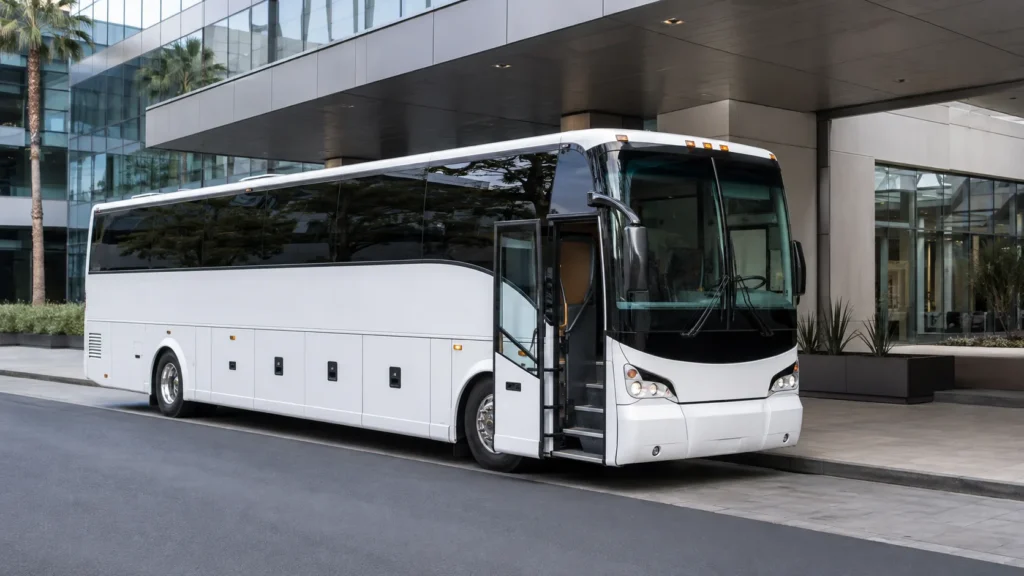
FAQ: Frequently Asked Questions

What is a deadhead fee?

It’s the cost of moving the vehicle from the yard to your first stop, or from your last stop back to base, before or after your passengers ride.

Not always, but it’s common. Ask whether gratuity is built into the quote.

Sometimes, yes, but only with advance approval and usually only on certain vehicles and for adult groups. Ask before booking, especially for wedding parties or a family reunions outing.

More Blogs

How Much Does It Cost to Rent a Sprinter Van With a Driver?

If you want the fast answer, here it is: the cost to rent a sprinter van with a professional driver usually falls between $120 and $165 per hour, around $1,250 to $1,500 per day, and airport transfers often start around $350 to $400 in large markets. That said, sprinter van r

ental prices can move up or down based on rental duration, rental location, mileage, amenities, and demand.

So yeah, when people ask, how much does it cost to rent , the honest answer is: it depends on the trip. A quick airport run is one thing. A full-day wedding shuttle, corporate events, or long distance road trips are another. I’ve seen people compare quotes and assume one company was overpriced, then realize the cheaper option didn’t include wait time, tolls, or gratuity. That’s usually where the confusion starts.

Get an exact quote for your trip in minutes → https://allstarshuttles.com/

Typical Pricing Models: How Much Does It Cost Hourly, Daily, Weekly

Most sprinter van rentals are priced one of three ways: hourly, daily, or custom multi-day pricing.

Base numbers:

  • Hourly: $120–$165
  • Daily: $1,250–$1,500
  • Weekly or multi-day: custom quote based on distance, schedule, and driver time

Hourly pricing works best for short local service like airport transfers, dinners, concerts, or private events. 

Daily pricing usually makes more sense for:

  • Weddings
  • Business travel
  • Multi-stop itineraries.

    Long term rentals or multi-day trips are often quoted separately because the total rental cost depends on mileage, hotels, and driver hours.

In my experience, hourly pricing looks great until the trip starts expanding. One stop turns into three. A pickup runs late. Somebody adds a dinner stop. Suddenly the “cheap” quote isn’t that cheap.

Mercedes Benz Sprinter vs Passenger Vans: Price and Capacity

A Mercedes Benz Sprinter is usually the sweet spot for comfort, image, and flexibility. A typical passenger sprinter van works well for smaller groups, usually around 10 to 15 passengers depending on the layout. A larger passenger van or minibus may carry more people for a similar hourly rate.


That’s why group size matters. If your group is small and wants a better ride, a Mercedes Benz sprinter van is often the better call. If you’re moving more people and comfort matters less, a larger passenger van may lower the rental cost per person.

Choose a standard sprinter van or luxury sprinter vans when you want:

  • a polished look for corporate travel
  • a spacious interior
  • better luggage room
  • nicer finishes like leather seats
  • room for group travel without jumping to a full bus

Choose a larger passenger van when:

  • your passenger count is higher
  • you want the lowest cost per seat
  • your transportation needs are simple

Honestly, this is where people overthink it. Pick based on headcount, luggage, and trip style. That’s it.

Camper Vans and Vanlife Options: Pricing Differences

Quick reality check: camper vans are not the same as chauffeured sprinter van rentals.

A sprinter van with a driver is built for moving people to events, airports, meetings, and special occasions. Camper vans and camper conversions are built for sleeping, cooking, and longer road trip use. Totally different animal.

That’s why camper vans often cost more in weird ways. You may see charges for:

  • bedding or kitchen kits
  • generator use
  • campsite gear
  • extra mileage
  • cleaning fees
  • pet add-ons

For family trips, weekend getaways, or visits to national parks, camper options can make sense. For weddings, executive transport, and airport transfers, not really. A chauffeured sprinter van rental is usually cleaner, easier, and less of a headache.

Airport Transfers: Rates, Tips, and Extra Charges

For airport service, many rental companies use flat rates instead of hourly pricing. A sprinter van airport transfer may start around $350 to $400, but the number changes fast depending on the airport, luggage, route, and pickup timing.

Here’s what to confirm before booking:

  • pickup terminal
  • luggage count
  • whether meet-and-greet is included
  • wait-time policy
  • tolls and airport fees
  • late-night pricing

During peak seasons, summer months, and major events, airport service can cost more. That’s especially true in cities like Los Angeles, Las Vegas, and San Francisco.

A simple airport quote can get messy fast if your group shows up with six oversized bags, golf clubs, and a stroller. Happens all the time.

What Affects Charter Bus Pricing?

Amenities and Comfort: Leather Seating, Power Outlets, Wi-Fi

The more upgrades you want, the higher the rental prices.

Popular luxury amenities include:

  • leather seats
  • Wi-Fi
  • power outlets
  • charging ports
  • premium sound
  • entertainment systems
  • better lighting
  • upgraded climate control

These luxury features are common in luxury vans, especially for executive travel and VIP trips. For a basic shuttle, they may not matter much. For client transport or corporate outings, they absolutely can.

Additional Services and Additional Fees To Expect

This is the part people miss. The base number is not always the final number.

Common additional services and additional fees include:

  • tolls
  • parking fees
  • airport fees
  • wait time
  • gratuity
  • overtime
  • cleaning fees
  • fuel surcharges
  • mileage charges

You should also check:

  • rental insurance
  • liability coverage
  • cancellation terms
  • damage rules
  • smoking rules
  • what the rental agreement says about delays

Some quotes also separate fuel costs, and some bundle them into the rate. Ask. Don’t guess.

Trip Distance & Duration

This one’s simple: the longer the trip, the higher the rental cost. More miles, more hours, more driver time, more chance of overtime. That’s why rental duration is one of the biggest pricing factors.

Location (City & Demand)

Your rental location can have a big impact on pricing because busy cities usually mean higher demand, tighter availability, and more time spent in traffic or at crowded venues.

In service areas like Los Angeles, Las Vegas, and San Francisco, van rental prices often rise on weekends, around conventions, weddings, and major events, especially for airport transfers and small-group bookings.

Los Angeles tends to bring longer drive times and heavier traffic, Las Vegas sees demand spikes around tourism and trade shows, and San Francisco often involves tighter routes, airport timing, and luggage-heavy group travel. That’s why the same sprinter van can cost more depending on the city and the date.

Seasonality (Peak vs Off-Peak)

Rates often rise during peak seasons, wedding season, holidays, and convention periods. Off peak seasons can bring better availability and sometimes discounted rates.

Bus Availability

Fleet availability matters more than people think. If only a few luxury sprinter vans are left, the price usually goes up.

Driver Costs (hotel, overtime)

For longer trips, driver-related costs can include:

  • overtime
  • hotel stay
  • late-night service
  • meal allowance
  • extended wait time

That’s why prices vary based on more than just the van itself.

How To Rent A Sprinter: Step-By-Step With A Driver

If you want to rent a sprinter van without wasting time, here’s the clean process:

  1. Send us the trip details
    Date, pickup time, passenger count, luggage, stops, and destination.
  2. Choose the right van type
    Ask whether you need a passenger sprinter van, standard sprinter van, or premium option.
  3. Ask about the driver
    Confirm the company provides a qualified professional driver.
  4. Check mileage rules
    Ask about mileage limits, daily mileage limit, and mileage overages.
  5. Review the written quote
    Make sure it includes taxes, gratuity, tolls, parking, and other extras.
  6. Read the cancellation terms
    This matters a lot for longer rentals, holidays, and busy weekends.
  7. Book early
    The earlier you rent a sprinter, the better your odds on price and availability.

Real-World Charter Bus Cost Examples

These are useful planning numbers, not fixed rates.

Wedding Shuttle (Local Trip)

Expect around $1,200–$1,800 depending on hours, venues, and waiting time. Add more if you want premium amenities or multiple shuttle loops.

Corporate Event Transportation

For corporate events, expect around $1,500–$3,000 per day depending on timing, standby hours, and service level. This is where a Mercedes Benz Sprinter really makes sense.

School Field Trip

A short local trip may land around $900–$1,500, depending on distance and the best-fit vehicle.

Long-Distance Charter (Multi-Day)

Multi-day service often runs $3,000–$7,000+ once hotels, mileage, driver time, and additional fees stack up.

How to Save Money on Charter Bus Rentals

We recommend you to save some money

  • book early
  • travel on weekdays
  • avoid peak seasons
  • match the van size to your group
  • combine stops instead of splitting rides
  • ask about pricing on longer rentals

Also, compare the full quote not just the base rate. A lower number with hidden fees is not a deal. It’s bait.

Local Considerations: Los Angeles, Las Vegas, and San Francisco

If you’re booking in Los Angeles, Las Vegas, or San Francisco, availability can change fast. These cities see strong seasonal demand, event traffic, airport congestion, and pricing swings around conventions and weekends.

Before you rent, confirm:

  • service coverage
  • airport rules
  • insurance details
  • toll handling
  • cross-border limits
  • whether one way rentals are allowed

This matters even more for group trips, corporate travel, and special events where timing is tight.

Final Recommendations

So, how much does it cost to rent a sprinter van with a driver?

For most trips, a good starting point is $120–$165 per hour or $1,250–$1,500 per day, with airport transfers often starting around $350–$400. But the real cost to rent depends on van type, mileage, stops, amenities, city, and schedule.

My advice in Summary ? Choose the vehicle based on passenger count, luggage, and itinerary not just the cheapest number. A sprinter van is often the best fit for group travel, corporate events, family trips, and special occasions because it balances comfort, image, and efficiency.

And before you book, get every detail in writing: mileage, gratuity, wait time, additional services, and cancellation terms.

Ready to rent a van with us?
https://allstarshuttles.com/

FAQs

Do I need a standard driver’s license for a chauffeured rental?

If you book a van with a driver, the company provides the driver. So your standard driver’s license is generally not the issue.

What are typical mileage limits and overage charges?

That varies by company. Always ask about mileage limits, the daily mileage limit, and what mileage overages cost before signing.

What cancellation policies are common?

Most rental companies have cancellation windows, deposit rules, and refund terms in the rental agreement. Read them before you pay.

Are fuel costs included?

Sometimes. Some providers include fuel costs, some break them out separately. Always verify.

Are cargo vans cheaper?

Usually, yes. But cargo vans are not the same as a chauffeured sprinter van rental. Different service, different comfort level, different experience.