
Autobús Charter vs Minibús: ¿Cuál es Mejor para su Viaje Grupal?
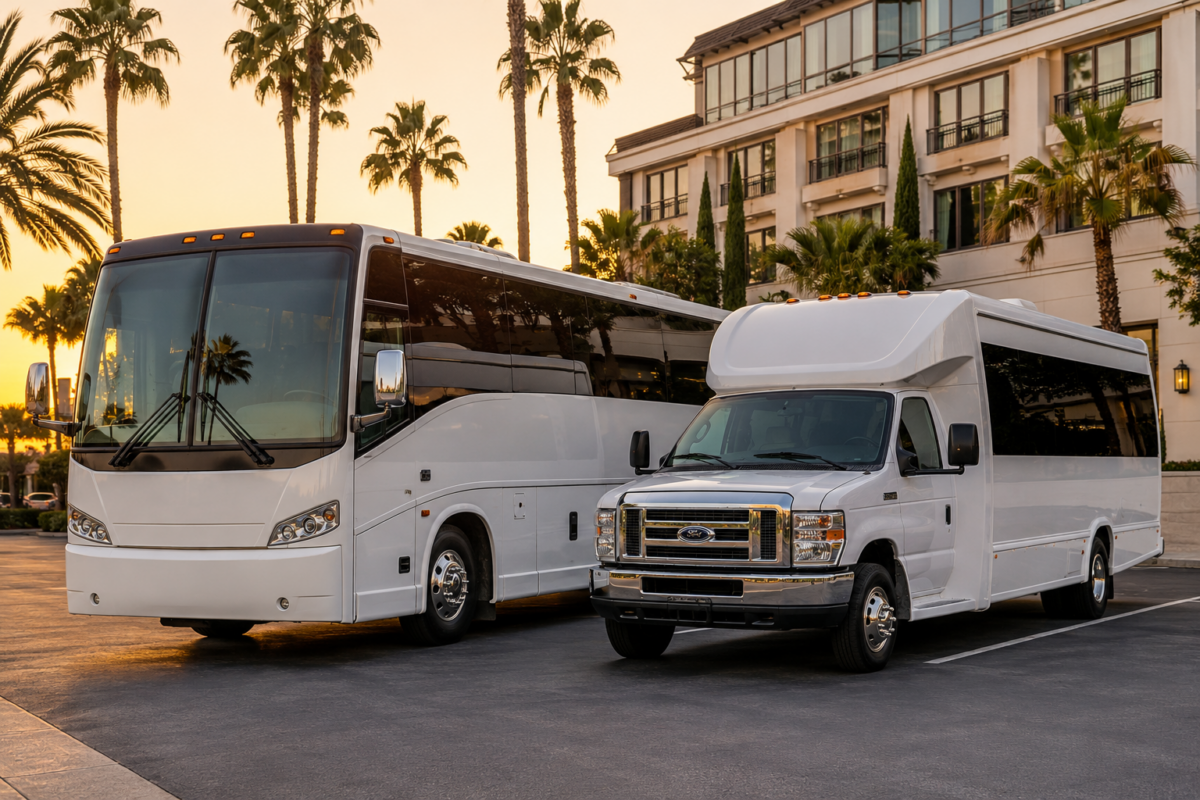
Deciding between a autobús charter vs minibus comes down to three things: group size, trip duration, and what your pasajeros need on board. Get the right vehicle and you save money, simplify logistics, and give su grupo a comfortable ride. Get it wrong and you’re paying for empty seats — or worse, squeezing people into a smaller vehicle that wasn’t built for the route. This comparison is for event planners, HR teams, wedding coordinators, and anyone planning transporte grupal in Los Ángeles who wants a clear, side-by-side breakdown before requesting a quote.

Key Differences Between a Autobús Charter and a Minibus
The main difference between a autobús charter and a minibus comes down to capacity, range, and what each vehicle offers on board. Here are the top three differentiators:
- Capacity: A full-size bus seats 36 to 56 pasajeros. A minibus seats 18 to 35. If your headcount is under 35, a minibus avoids wasted empty seats and reduces cost.
- Amenities: A motor coach comes standard with an onboard restroom, overhead bins, power outlets, Wi-Fi, and high back reclining seats. Most minibuses offer reclining seats, climatización, and a PA system — but restrooms are only on select 30- and 35-passenger models.
- Range: Charter buses are built for long-distance travel — multi-hour routes, overnight trips, and interstate runs. Minibuses are optimized for local travel, city travel, and shorter trips under two hours.
Cost-per-passenger is the most useful decision lever. Divide the total quote by your headcount for both options. A full sized autobús charter often wins on cost-per-seat for groups over 36. For smaller groups, a minibus — or even two minibuses — is more cost efficient.
What Is a Autobús Charter?
A autobús charter — also called a motor coach or full-size coach — typically seats between 36 and 56 pasajeros. It’s the larger vehicle in commercial transporte grupal, built for comfort over long distances and extended trip durations.
Standard long-distance amenities on a autobús charter include:
- Onboard restroom — standard on all full-size coaches
- Overhead storage / overhead bins and undercarriage storage compartment for heavy luggage
- High back reclining seats with footrests for a smoother ride on multi-hour routes
- Wi-Fi, power outlets, and entertainment systems on modern fleets
- Air conditioning with dual-zone climatización
Charter buses are the right choice for large groups heading to sporting events, corporate conferences, multi-day tours, long-distance travel between cities, or any trip where luggage and passenger comfort over several hours are priorities.
What Is a Minibus?
A minibus seats 18 to 35 pasajeros — sized between a Sprinter van and a full size bus. It’s the workhorse vehicle for shorter journeys, multi-stop local tours, and mid-size groups that don’t need a 56-seat coach.
Where minibuses have limitations compared to a full-size coach:
- No restroom on most 18- and 24-passenger models
- Less storage space — no undercarriage bay on smaller configurations
- Fewer luxury features — entertainment systems are not standard
Minibuses excel for airport transfers, hotel-to-venue shuttle loops, local tours, wedding group transfers, school field trips, and any route where city travel and tight venue access matter more than long-haul amenities. For a deeper look at the full minibus fleet, see our alquiler de minibús Los Ángeles guide.
Group Size Guidance
| Headcount | Recommended Vehicle | Notes |
|---|---|---|
| Up to 14 | Sprinter Van | Most cost-efficient for small groups |
| 15–35 | Minibus | Right-sized capacity, better for city routes |
| 36–56 | Autobús Charter | Full amenities, undercarriage storage, restroom |
| 57+ | Multiple vehicles | Two minibuses or a coach + minibus combination |
Two rules of thumb: first, if your headcount is within five seats of a vehicle’s capacity limit, step up to the next size — a full bus is safer than an overloaded one. Second, always calculate cost per passenger across both options before committing. Two minibuses sometimes beat one autobús charter for groups in the 40–50 range when routing or timing differs.
Trip Length: Local Travel vs Long-Distance Travel
Trip duration is often the fastest way to determine the right vehicle:
- Under 2 hours / local travel: A minibus handles short distance transportation well. Hotel pickups, airport transfers, venue loops, and city travel within Los Ángeles all fall here.
- 2–5 hours / regional: Either vehicle works depending on group size. If the trip involves significant luggage or pasajeros who need a restroom, lean toward a autobús charter.
- 5+ hours / long distance: Choose a autobús charter. Long trips demand the asientos cómodos, restroom, and storage space that a full sized autobús charter provides. A minibus on a 6-hour run is a compromised experience.
For short, multi-stop itineraries — convention center to hotel to restaurant to venue — a minibus is the perfect ride. It navigates drop-off zones and hotel forecourts where a full coach can’t stage safely.
Amenities, Luggage, and Comfort
| Feature | Autobús Charter | Minibus |
|---|---|---|
| Seating | High back reclining seats, footrests | Reclining seats, standard cushioning |
| Restroom | Standard on all coaches | Select 30–35 passenger models only |
| Luggage | Overhead bins + undercarriage bay | Overhead storage, limited undercarriage |
| Wi-Fi | Standard on modern fleets | Select vehicles |
| Power Outlets | Standard | Select vehicles |
| PA System | Standard | Select vehicles |
| Climate Control | Dual-zone air conditioning | Single-zone climatización |
| Entertainment | DVD/monitor systems on select coaches | Not standard |
For groups with heavy luggage — sports equipment, trade show materials, or checked bags from an international flight — the undercarriage storage compartment on a autobús charter is a significant advantage. A minibus’s overhead storage handles carry-on sized bags but not much more.

Cost and Value Comparison
Always compare total cost against cost per passenger — not just the headline quote. A autobús charter at $1,400/day sounds expensive until you divide by 50 pasajeros ($28/person). A minibus at $700/day for 20 pasajeros is $35/person.
Scenarios where two minibuses beat one autobús charter:
- Your group of 45 splits across two pickup locations — two minibuses run simultaneous routes more efficiently than one large coach doing two loops
- The destination has restricted loading zones that won’t accommodate a full-size coach
- Your event has staggered departure times and one coach would sit idle between runs
Always factor driver time, fuel, tolls, and parking permits into your total. For a full breakdown of what drives cost on both vehicle types, see our California autobús charter cost guide.
Airport Transfers and Shuttle Use
For airport transfers, vehicle choice depends on group size and luggage volume:
- Use a minibus for groups of 15–30 arriving at LAX, Burbank (BUR), or Ontario (ONT) with standard carry-on luggage. A minibus accesses terminal curbs and rideshare zones that a full coach cannot.
- Use a autobús charter for large teams of 36+ with checked bags, sports equipment, or trade show freight. The undercarriage bay handles volume that overhead racks can’t.
For group airport logistics across Los Ángeles, see our Los Ángeles shuttle al aeropuerto service.
Corporate Events, Sports Teams, and Transporte Grupal
For evento corporativos — conference shuttles, offsite meetings, and corporate retreat transfers — match the vehicle to your department headcount. A 24–30 passenger minibus moves a full team without the overhead of a 56-seat coach. For recurring daily routes and transporte grupal between offices and transit hubs, a dedicated minibus contract is more cost-efficient than booking individual rides. See our shuttle corporativo service Los Ángeles for recurring route precios.
Sports teams traveling to away games and sporting events typically need a autobús charter when equipment is involved — jerseys, bags, and gear fill the undercarriage fast. For fitness groups, youth leagues, and club teams with lighter gear, a minibus is often sufficient and easier to park near stadium drop-off zones.

Urban Navigation and Venue Access
Minibuses have a clear advantage in dense city travel. They navigate tight streets in West Hollywood, Beverly Hills, and Downtown LA that a full-size coach struggles with. Hotel forecourts on Wilshire Boulevard, boutique venue entrances, and event drop-off lanes are all designed for smaller vehicles.
Charter buses require larger loading zones or dedicated curb space — most major venues (Dodger Stadium, Crypto.com Arena, the Los Ángeles Convention Center) have designated coach staging areas, but smaller venues often don’t. If your destination is an urban restaurant, rooftop venue, or boutique hotel, confirm coach access before booking.
Bus vs Minibus: Safety and Accessibility
Both vehicle types are regulated as commercial passenger carriers and must meet NHTSA bus safety standards and federal FMCSA driver requirements. Key points to verify with any provider:
- Driver holds a valid CDL with passenger (P) endorsement
- Vehicle carries adequate commercial liability insurance
- DOT number is active and inspection records are current
On accessibility: wheelchair lifts are available on select vehicles in both categories — flag accessibility needs when requesting your quote so the right vehicle is assigned. Not all minibuses are ADA-equipped, and the same applies to charter coaches.
Choose a Minibus When…
- Your group is 15–35 pasajeros — no wasted empty seats, lower total cost
- The route requires curbside pickup, tight turns, or urban venue access
- Trip duration is under two hours and luggage needs are light
- You’re running a multi-stop shuttle loop — hotel, venue, restaurant, hotel
- Your event is a wedding group transfer, bachelorette party, or school field trip
Choose a Autobús Charter When…
- Your group is 36 or more pasajeros — fills the coach and brings cost-per-seat down
- You have heavy luggage, sports gear, or equipment requiring undercarriage storage space
- Trip duration is over 3 hours or involves long distance travel
- An onboard restroom is necessary for passenger comfort
- Amenities like Wi-Fi, power outlets, and asientos cómodos matter for the group travel experience
Final Call: How to Decide and Next Steps
Quick decision checklist before you request a quote:
- Count your pasajeros — under 35 points to a minibus; 36+ points to a autobús charter
- Check trip length — under 2 hours favors a minibus; over 3 hours favors a coach
- Assess luggage — heavy bags or sports gear? Charter bus wins on storage
- Confirm venue access — tight urban drop-off? Minibus navigates better
- Calculate cost per passenger for both options — the numbers often decide it
When requesting quotes, ask providers to confirm which amenities are included, whether the driver holds a current CDL-P endorsement, and what the cancellation and insurance policy covers. For All Star Shuttles’ full fleet comparison across all vehicle types, see our autobús charter vs sprinter van guide.